Vietnam is moving rapidly toward universal preschool education. The next challenge is not simply increasing enrollment. It is ensuring that schools and teachers can deliver consistent, developmentally appropriate early childhood education across very different classrooms, communities and levels of teacher experience.
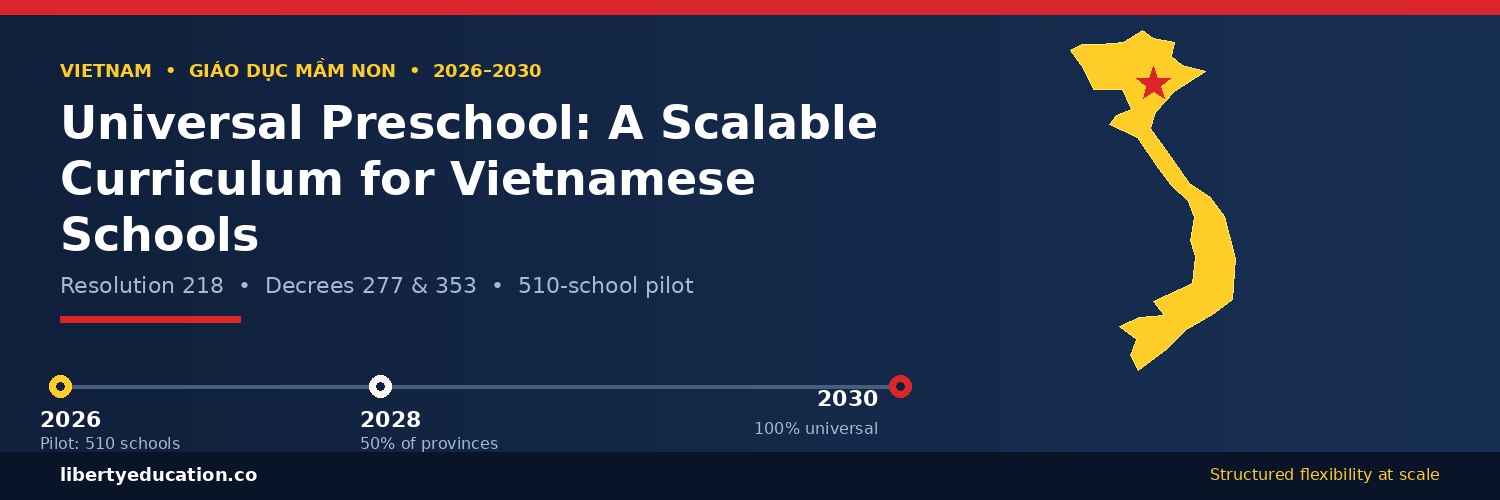
In June 2025, Vietnam's National Assembly adopted Resolution 218/2025/QH15 on universal preschool education for children ages 3 to 5. The implementation framework established by Decree 277/2025/ND-CP sets an ambitious national timetable: by 2028, at least 50% of provinces and centrally governed cities are expected to meet universalization standards, rising to 100% by 2030.
Vietnam is simultaneously reforming what happens inside preschool classrooms. During the 2026–2027 school year, the Ministry of Education and Training is piloting a new preschool education program at 510 institutions nationwide. The program places greater emphasis on child-centered learning, competencies, flexibility, teacher autonomy and adaptation to local conditions.
In practical terms, Vietnam's universal preschool expansion requires more than increased enrollment. Schools need structured curriculum resources, teacher support, consistent learning progression and systems that can scale while remaining adaptable to individual children and local communities. Liberty Education is designed around this combination of structure, flexibility and teacher support.
That is why Vietnam's preschool expansion represents more than a need for additional classrooms.
It creates a need for a practical curriculum delivery system.
Vietnam Universal Preschool: The Key Facts
Vietnam's direction is now clear.
Resolution 218/2025/QH15 establishes the national policy of universal preschool education for children ages 3 to 5.
Decree 277/2025/ND-CP sets the implementation roadmap, including the target of at least 50% of provinces and centrally governed cities meeting universalization standards by 2028 and 100% by 2030. The decree also addresses school networks, facilities, teaching equipment, staffing and policies supporting preschool children and educators.
Vietnam has also introduced Decree 353/2026/ND-CP covering preschool universalization for children ages 5 to 6, alongside provisions concerning compulsory education and literacy. The decree was issued September 11, 2026 and takes effect November 1, 2026.
At the same time, the Ministry of Education and Training's new preschool program is being piloted during the 2026–2027 school year at 510 preschool institutions representing different geographic areas and school conditions.
Together, these initiatives signal a significant new stage for early childhood education in Vietnam.
The policy direction is established.
The next challenge is delivery.
What Does Vietnam's Universal Preschool Expansion Require From Schools?
Universalization creates an important quality question.
How can Vietnam increase access while ensuring that children in different schools receive coherent, developmentally appropriate learning experiences?
A national program establishes objectives and expectations. But teachers still need to translate those objectives into what happens in the classroom each day.
That becomes particularly important under a more flexible, child-centered model.
Vietnam's new preschool program is moving toward a competency-based approach with greater flexibility for schools and teachers. It emphasizes four qualities — love, respect, honesty and responsibility — and five competencies: independence, adaptability, communication, cooperation and problem solving.
This direction recognizes an important truth about early childhood education:
Children do not all learn in exactly the same way, at exactly the same speed.
But flexibility alone is not enough.
For teachers to use that flexibility effectively, they need curriculum structure, appropriate resources, developmental progression and practical guidance.
This creates three immediate implementation needs.
1. Schools Need to Make Quality Teachable
Broad educational objectives must ultimately become classroom activities.
Teachers need to know what children are expected to learn, how learning develops progressively, what activities can support those objectives, and how lessons can be adapted when children need additional support or greater challenge.
A strong preschool curriculum therefore needs both clear progression and room for professional judgment.
2. Teachers Need Support Without Losing Autonomy
Teacher autonomy should mean having meaningful choices about how to respond to children.
It should not mean that every preschool teacher must build every lesson, activity and resource from the beginning.
Vietnam's own implementation discussions recognize this challenge. The Ministry has called for support for teachers, reduced unnecessary administrative pressure, practical professional development and shared digital learning resources.
The opportunity is therefore not to replace teacher judgment.
It is to give teachers a stronger starting point.
3. Curriculum Systems Must Work at Scale
A curriculum that works in one well-resourced school is not necessarily a curriculum capable of supporting universal preschool.
Vietnam needs approaches that can function across different school types, communities and levels of infrastructure.
That means providing enough consistency to support quality while retaining enough flexibility for local language, culture, teacher experience, available materials and individual children's needs.
This is the point at which curriculum design becomes a systems question.
And it is where Liberty Education offers a particularly strong fit.
How Does Liberty Education Support Vietnam's Preschool Expansion?
Liberty Education was designed around a principle that closely matches the challenge Vietnam now faces:
Provide teachers with structure without removing flexibility.
Liberty's international preschool curriculum addresses early literacy, early numeracy, language development, science, STEAM, creativity, physical development, social-emotional development, critical thinking and problem solving.
The curriculum's foundation includes the California early learning frameworks and a structured yet flexible approach intended to support whole-child development, meaningful language interactions, experiential learning and adaptation to children's individual needs.
That matters in Vietnam because a scalable early childhood curriculum cannot simply provide content.
It must help teachers deliver that content consistently.
From Curriculum Objectives to Monday Morning in the Classroom
Education policy ultimately succeeds or fails in a very practical place:
the classroom.
A learning objective has limited value if teachers do not have a realistic way to deliver it.
Liberty Education therefore combines student materials with detailed Teacher Guides that translate learning objectives into practical teaching choices.
For example, Liberty's phonics materials do not simply identify a letter that a child should learn. Teacher resources connect phonics with vocabulary, storytelling, conversation, fine-motor development, gross-motor movement, science, social-emotional learning and creative activities.
A single early literacy topic can therefore become an integrated learning experience rather than an isolated worksheet.
The same principle appears in mathematics. Early numeracy instruction connects number recognition and writing with movement, language, objects, problem solving, fine-motor activities and real-world understanding.
This gives teachers something extremely valuable:
a professional starting point.
They know the objective.
They have activity choices.
They can see the developmental connections.
They can then adapt the learning experience to the children in their classroom.
Structured Curriculum Does Not Have to Mean Rigid Teaching
One of the most important characteristics of Liberty Education is the distinction between structure and prescription.
A curriculum can establish progression without dictating every moment of the school day.
Liberty gives teachers learning objectives, curriculum sequencing, resources and activity choices while allowing educators to modify delivery according to student development, interests, language, culture and classroom conditions.
This is highly compatible with the direction of Vietnam's new preschool program.
Vietnam's pilot emphasizes flexibility and recognizes that children may reach the same educational objective through different experiences. Reporting on the 2026–2027 pilot has similarly highlighted the importance of teachers observing children and adapting how activities are organized.
The objective remains clear.
The path can change.
That is structured flexibility.
International Benchmarking With Vietnamese Localization
Liberty Education's curriculum can also provide Vietnamese schools with an international reference point.
Its learning domains and teaching approach can be mapped against international early-years frameworks, including the UK Early Years Foundation Stage and Singapore's Nurturing Early Learners framework. Liberty's existing standards work identifies substantial correspondence in communication and language, literacy, mathematics, physical development, social-emotional development, discovery of the world, creative expression, learning dispositions and observation-based assessment.
But international benchmarking should not mean importing another country's preschool system unchanged.
For Vietnam, the appropriate model is different.
Vietnam's national preschool objectives remain the framework. Liberty provides additional curriculum structure and implementation resources that can be mapped and localized to support those objectives.
Vietnamese schools remain Vietnamese schools.
Vietnamese educators retain professional judgment.
Local language, cultural examples, stories and classroom experiences can be incorporated.
International benchmarking strengthens the academic foundation without requiring schools to give up local identity.
This is particularly relevant for international schools, bilingual schools, private preschool groups and organizations looking for a Vietnam preschool curriculum solution with an international dimension.
Print + AI: A Practical Model for Different Vietnamese Classrooms
Digital transformation is increasingly important in education.
But a national early childhood solution also has to acknowledge reality: not every classroom will have identical devices, connectivity or digital infrastructure.
For this reason, Liberty Education uses a print + AI approach.
The printed curriculum and Teacher Guides provide the instructional foundation.
Teaching does not stop because a classroom has limited technology.
Where technology is available, Liberty's curriculum-focused AI Assistant can provide an additional planning and differentiation layer.
Teachers can use AI support to adapt an activity, develop additional questions, create alternative learning approaches, increase or decrease difficulty, connect lessons across developmental areas or generate ideas for individual and small-group learning.
The curriculum remains the anchor.
The teacher remains the decision-maker.
The technology provides support.
That relationship is especially important in early childhood education, where play, movement, social interaction, observation and relationships cannot be replaced by screens or automated systems.
Vietnam's current preschool reform similarly emphasizes shared digital resources while keeping professional teaching and real classroom experience at the center of implementation.
The model can therefore be summarized simply:
Print provides reliability.
AI provides adaptability.
Teachers provide judgment.
Can Liberty Education Work Within Vietnam's MOET Preschool Framework?
Yes — and this is an important distinction.
Liberty Education should not be positioned as a replacement for Vietnam's national preschool framework.
It is better understood as an implementation resource that can be mapped and localized to support national objectives.
Vietnam determines the national educational framework and regulatory requirements.
Liberty can provide the structured scope and sequence, classroom content, Teacher Guides, activities, differentiation resources, international benchmarking and AI-assisted planning that help schools implement high-quality early childhood education.
That makes Liberty more than a set of preschool textbooks.
It makes the curriculum a potential delivery platform.
Why Licensing Matters for Vietnam
Liberty Education uses a curriculum licensing approach rather than requiring schools to become part of a franchise system.
That distinction has important advantages.
A school can retain its own name, identity, culture and operating model while adopting a common curriculum structure.
A school group can establish greater consistency across multiple campuses.
A larger education organization can establish common learning progression while allowing local adaptation.
And, with appropriate mapping, localization, teacher preparation and regulatory approval, the same architecture can potentially support implementation at provincial or wider system level.
The model is therefore capable of growing from one classroom to many classrooms without requiring every classroom to become identical.
Why the 2026–2028 Window Matters
Vietnam's first major universalization milestone is approaching quickly.
By 2028, Decree 277 calls for at least half of provinces and centrally governed cities to meet preschool universalization standards for children ages 3 to 5. By 2030, the target is 100%.
At the same time, the 2026–2027 pilot is providing Vietnam with real-world evidence about how the new preschool program operates across very different settings.
The 510 participating institutions include different school types and geographic conditions, reflecting Vietnam's recognition that successful implementation must work beyond a single type of classroom.
This creates an important window for schools and education organizations.
The institutions preparing now can begin developing the curriculum structure, teacher support, shared resources and implementation systems they will need as universal preschool expands.
Why Liberty Education Is a Strong Fit for Vietnam
Vietnam's challenge is no longer simply establishing the importance of early childhood education.
The challenge is delivering it consistently, sustainably and at scale.
Liberty Education addresses the practical issues that emerge when a preschool system expands:
Clear learning progression helps schools establish consistency.
Detailed Teacher Guides reduce unnecessary planning burden while preserving teacher choice.
Early literacy, numeracy, STEAM, creativity, physical development, social-emotional learning and critical thinking support whole-child development.
Printed resources make implementation less dependent on classroom technology.
AI-assisted planning and differentiation provide additional support where digital infrastructure is available.
International benchmarking provides an academic reference point.
Local adaptability allows curriculum delivery to respond to Vietnamese children, communities and school environments.
Licensing rather than franchising creates a pathway for adoption from an individual school to a much larger education system.
The result is not rigid standardization.
It is structured flexibility at scale.
And that is precisely the combination Vietnam's next phase of preschool development requires.
The Question Is No Longer Whether Vietnam Will Expand Preschool
Vietnam has already set its direction.
The more important question now is:
How can high-quality early childhood education be delivered across thousands of classrooms while supporting teachers, respecting local contexts and responding to individual children?
That question cannot be answered by enrollment targets alone.
It requires teachers.
It requires resources.
It requires curriculum.
It requires implementation systems that work in real classrooms.
Liberty Education brings those elements together through structured curriculum, detailed Teacher Guides, printed learning materials, international benchmarking, adaptable teaching resources and curriculum-supported AI.
For international schools in Vietnam, private preschool groups, bilingual schools, education organizations, provincial partners and institutions exploring larger-scale early childhood education solutions, Liberty Education offers a practical bridge between educational objectives and everyday classroom delivery.
Internationally benchmarked.
Locally adaptable.
Teacher-friendly.
Print-ready.
AI-supported.
Built to scale.
That combination makes Liberty Education a strong fit for the next phase of early childhood education in Vietnam.
Frequently Asked Questions About Universal Preschool in Vietnam
What is Vietnam's universal preschool policy?
Vietnam's Resolution 218/2025/QH15 establishes the national policy of universal preschool education for children ages 3 to 5. Decree 277/2025/ND-CP provides the implementation framework and sets targets for at least 50% of provinces and centrally governed cities to meet universalization standards by 2028 and 100% by 2030.
Is preschool compulsory for every 3-to-5-year-old child in Vietnam?
The current policy is more accurately described as universalization of preschool education, rather than describing preschool for all children ages 3 to 5 as compulsory education. Using the official terminology is important when discussing Vietnam's policy with schools, education authorities and government partners.
What is changing in Vietnam's preschool curriculum?
Vietnam is piloting a new preschool education program during the 2026–2027 school year at 510 preschool institutions. The program emphasizes child-centered learning, competencies, flexibility, greater teacher autonomy and adaptation to different children and local contexts.
Does Liberty Education replace Vietnam's MOET preschool program?
No. Liberty Education can be mapped and localized as an implementation resource supporting Vietnamese educational objectives. The national framework remains determined by Vietnam's Ministry of Education and Training.
How can Liberty Education reduce preschool teacher workload?
Liberty provides structured learning progression, student materials and detailed Teacher Guides with objectives and activity choices. Teachers therefore begin with an organized instructional framework rather than developing every lesson and activity from scratch.
Can Liberty Education work in schools with limited technology?
Yes. The core curriculum uses printed materials and Teacher Guides. AI support is an additional layer rather than a requirement for basic classroom delivery.
How can AI support preschool teachers?
Curriculum-focused AI can help teachers differentiate activities, develop supplementary questions, modify difficulty, connect learning domains and generate additional lesson ideas. The teacher remains responsible for selecting developmentally appropriate activities and determining how they should be used with children.
Can Liberty Education be used by international and bilingual schools in Vietnam?
Yes. Its international orientation, structured literacy and numeracy progression, whole-child approach and adaptability make it particularly relevant to international schools, bilingual preschools and school groups seeking a structured international preschool curriculum that can also be localized for Vietnam.
Can Liberty Education scale beyond a single school?
The licensing model is designed to support implementation beyond a single classroom or campus. Larger implementations can combine common curriculum structure with localized content, training and adaptation to regulatory requirements.
See How Liberty Education Works in a Real Classroom
Vietnam's universal preschool expansion requires solutions that work not only in policy documents, but in real classrooms with real teachers and children.
Book a 20-minute Liberty Education demonstration to see how the curriculum, Teacher Guides and AI Assistant work together to turn learning objectives into practical classroom activities.
Visit LibertyEducation.co to request a demonstration, explore licensing for schools or larger education systems, and request sample curriculum materials.