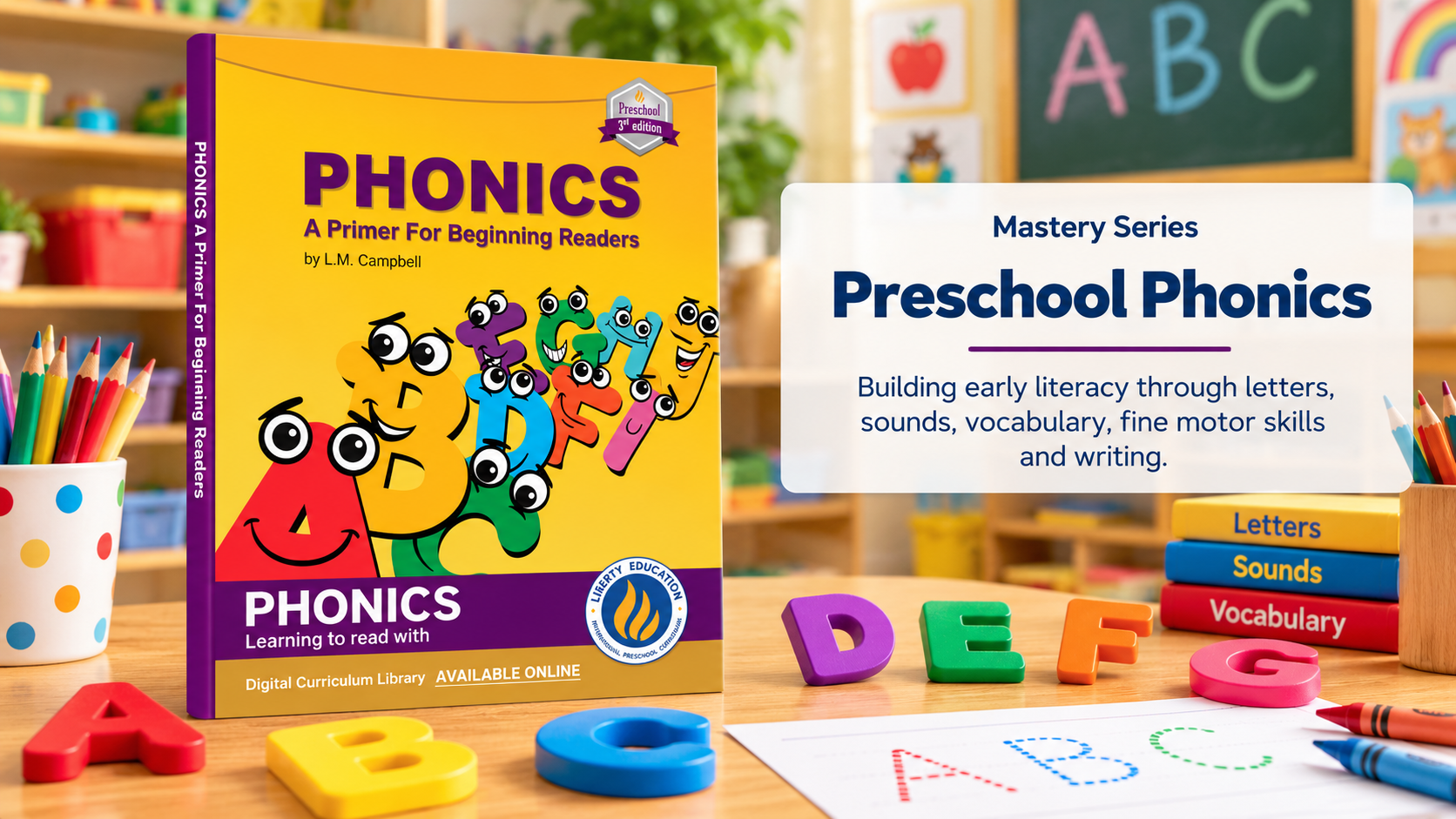
The Mastery Series • Preschool • Phonics
Preschool Phonics
Developing beginning literacy through pre-writing skills, letter sounds, vocabulary, beginning-sound awareness, letter formation and writing.
Developing Beginning Literacy
Preschool Phonics is the second Phonics level in the Mastery Series from Liberty Education. It builds on children's early familiarity with letters and sounds and develops stronger sound discrimination, letter formation, vocabulary and writing foundations.
The program begins with pre-writing skills that prepare children for letter formation. Children then work systematically with letters and their sounds, identify words beginning with target sounds, practice writing uppercase and lowercase letters and continually review previously learned alphabet knowledge.
A structured Student Book works together with a detailed Teacher Guide to connect visual, auditory, oral and fine-motor learning through teacher modeling, songs, movement, vocabulary, hands-on activities and guided practice.
Preschool Phonics at a Glance
| Series | Mastery Series Early Childhood Curriculum |
|---|---|
| Level | Preschool |
| Subject | Phonics |
| Curriculum Focus | Beginning Literacy |
| Alphabet | Uppercase and lowercase A–Z |
| Key Learning Areas | Pre-writing skills, alphabet knowledge, letter sounds, beginning sounds, vocabulary, uppercase and lowercase letters, letter formation, writing, alphabet sequence and cumulative review |
| Curriculum Components | Teacher Guide and Student Book |
| Author | L.M. Campbell and Liberty Education's Curriculum Development Team |
| Edition | Third Edition |
| Publisher | Liberty Education |
What Children Learn
Preschool Phonics develops beginning literacy through connected experiences with pre-writing, letters, sounds, vocabulary, oral language and letter formation.
Pre-Writing Skills
Before beginning formal letter practice, children develop the movements and fine-motor control used in writing.
Pre-writing activities include:
- pencil-grip practice;
- vertical lines;
- horizontal lines;
- slanting lines to the left;
- slanting lines to the right;
- zigzag lines;
- curved lines;
- circular movements; and
- tracing familiar pictures.
These experiences prepare children for the controlled movements required to form uppercase and lowercase letters.
Alphabet Knowledge
Children develop recognition of the letters of the alphabet and become increasingly confident identifying and naming uppercase and lowercase letter forms.
Letter-Sound Connections
Children connect each target letter with its sound through listening, teacher modeling, repetition, pictures, songs and classroom activities.
The goal is to strengthen the relationship between what a letter looks like and the sound associated with it.
Beginning-Sound Awareness
Children identify pictures and familiar words that begin with target sounds. They listen to spoken words, notice the initial sound and connect that sound with the appropriate letter.
Activities may ask children to select, sort, circle or color pictures according to their beginning sounds.
Uppercase & Lowercase Letters
Children recognize and practice both uppercase and lowercase forms. Matching and identification activities reinforce the relationship between the two forms of each letter.
Letter Formation & Writing
Writing is a recurring part of the program. Children observe teacher demonstrations, form letters through movement and tactile activities, trace letter shapes and practice writing uppercase and lowercase letters.
Vocabulary Development
Each letter is connected with familiar vocabulary. Children name and discuss pictures, identify words beginning with the target sound and expand their spoken vocabulary through teacher-guided conversation.
Visual & Auditory Discrimination
Children learn to look carefully at letter forms and listen carefully to spoken sounds. They distinguish target letters from other letters and target beginning sounds from other sounds.
Alphabet Sequence
Cumulative activities strengthen children's understanding of alphabetic order. As more letters are learned, children arrange, recite and write increasingly larger groups of letters in sequence.
How Phonics Learning Develops
Preschool Phonics connects hearing, seeing, speaking and writing rather than treating letter learning as a single recognition task.
Prepare → Recognize → Identify → Hear → Discriminate → Connect → Form → Write → Apply → Review
A letter sequence may ask children to hear and say the target sound, recognize the letter, identify pictures beginning with the sound, practice the letter form and then write the letter.
This connects letter shape, letter sound, beginning-sound vocabulary and written formation within the same learning experience.
Inside the Student Book
The Preschool Phonics Student Book begins with pre-writing activities before moving into a structured sequence of letter-sound instruction.
For individual letters, children encounter recurring activities such as:
- learning the target letter sound;
- identifying words that begin with the target sound;
- recognizing uppercase and lowercase forms;
- practicing the target letter;
- writing uppercase and lowercase letters;
- working with picture vocabulary;
- finding target letters among other letters;
- completing beginning-sound activities; and
- reviewing previously learned letters and sounds.
The book's letter instruction begins with S, A, T, I, P and N before continuing through the wider alphabet sequence.
This allows children to develop familiarity with individual letter-sound relationships while cumulative review later reconnects those letters within alphabetic order.
From Pre-Writing to Letter Formation
Preschool Phonics gives explicit attention to the physical foundations of writing before children are expected to repeatedly form letters.
The Teacher Guide begins with pencil-grip practice and teacher demonstrations of the line movements used in the Student Book. Children practice straight, slanting, zigzag, curved and circular movements before applying similar motor patterns to letter formation.
Fine-motor development can also be strengthened through hands-on experiences such as playdough, cutting, lacing, beading, finger activities, painting, clothespins and manipulating small objects.
Grip → Control → Trace → Form → Practice → Write
Cumulative Alphabet Review
Preschool Phonics includes planned review as children progress through the program. Previously learned letters are revisited rather than practiced only once.
Major cumulative reviews include:
- Review A–F
- Review A–J
- Review A–O
- Review A–Z
Review activities reinforce uppercase and lowercase matching, letter recognition, letter sounds, beginning-sound vocabulary, alphabet sequence and writing.
Teacher-Guided Phonics Learning
The Preschool Phonics Teacher Guide expands Student Book activities into multisensory classroom experiences.
Teachers model letter sounds and letter formation and guide children in listening for sounds, identifying picture words, matching letters and applying vocabulary.
Letter learning can also extend beyond pencil-and-paper work. Children may form letters in the air, construct letters with classroom materials, search for hidden letters, sort pictures according to beginning sounds or participate in movement activities that require them to identify a letter or sound.
These experiences allow children to revisit the same literacy concept through sight, sound, speech, movement and touch.
How Children Learn
Preschool Phonics uses active, multisensory experiences to develop beginning literacy.
Depending on the lesson, children may learn through:
- teacher modeling and guided discussion;
- stories, songs and rhymes;
- listening to and repeating target sounds;
- picture and vocabulary activities;
- beginning-sound identification;
- uppercase and lowercase matching;
- alphabet sequencing;
- tracing and writing;
- air writing and large-motor letter formation;
- fine-motor activities;
- art and craft experiences;
- sensory letter formation;
- games and manipulatives;
- learning centers; and
- Student Book practice.
Learning Centers & Classroom Exploration
Teacher Guide activities extend phonics learning into classroom centers where children can revisit letters, sounds, vocabulary and writing in different ways.
- Literacy & Language: letter recognition, letter sounds, picture vocabulary and oral language
- Writing: tracing and practicing uppercase and lowercase letters
- Fine Motor: cutting, lacing, beading, painting, playdough and manipulation
- Sound & Picture Sorting: classifying pictures according to their beginning sounds
- Art: letter crafts, painting, coloring and construction
- Movement: action songs, letter searches and large-scale letter activities
- Sensory Exploration: forming and tracing letters with tactile materials
- Games & Manipulatives: matching, identifying and sequencing letters through hands-on play
Phonics & Whole-Child Development
Beginning literacy is the central curriculum focus, while Preschool Phonics also engages broader areas of early childhood development.
Language Development
Letter sounds, vocabulary, listening, speaking, discussion and beginning-sound awareness.
Cognitive Development
Recognition, memory, visual discrimination, auditory discrimination, matching, classification and sequencing.
Fine-Motor Development
Pencil control, line formation, tracing, writing, cutting, pasting, painting and manipulation.
Gross-Motor Development
Action songs, movement games, air writing and large-scale letter formation.
Social & Emotional Development
Participating in group activities, listening, taking turns, communicating and cooperating with classmates.
Creative Development
Art, stories, songs, movement and hands-on letter activities provide additional ways for children to explore sounds and written forms.
Preschool Phonics Curriculum Sequence
Preschool Phonics progresses from the physical foundations of writing into increasingly confident letter-sound recognition, beginning-sound awareness, letter formation and cumulative alphabet knowledge.
| Learning Area | Development |
|---|---|
| Pre-Writing Skills | Pencil grip, line control, tracing and fine-motor preparation |
| Alphabet Knowledge | Recognizing and naming uppercase and lowercase letters |
| Letter Sounds | Connecting target sounds with corresponding letters |
| Beginning Sounds | Identifying words and pictures beginning with target sounds |
| Uppercase & Lowercase | Recognizing and relating the two forms of each letter |
| Letter Formation | Tracing, practicing and writing uppercase and lowercase letters |
| Vocabulary | Developing familiar vocabulary associated with target letters and sounds |
| Alphabet Sequence | Arranging, reciting and writing increasingly larger groups of letters in order |
| Cumulative Review | Revisiting letter recognition, sounds, vocabulary, sequence and writing across A–F, A–J, A–O and A–Z |
Developmental Progression
Preschool Phonics forms the development-and-application stage between the foundational alphabet experiences of Nursery and the more advanced phonics work of Kindergarten.
Prepare → Recognize → Identify → Discriminate → Connect → Form → Write → Sequence → Apply → Review
Children strengthen their knowledge of individual letters and sounds while developing the visual, auditory and fine-motor skills needed for the next stage of literacy learning.
See how these skills develop across all three levels in the Mastery Series Phonics Curriculum Progression .
From Preschool to Kindergarten Phonics
Preschool Phonics strengthens the alphabet, sound-discrimination and writing foundations needed for the next stage of the Mastery Series Phonics pathway.
At Kindergarten level, children build on these foundations through more detailed work with beginning, middle and ending sounds, short vowels, blending, simple word reading, rhyming, word families, writing and early comprehension.
Scope & Sequence
Explore how Preschool Phonics fits within the complete developmental sequence of Mathematics and Phonics learning across Nursery, Preschool and Kindergarten.
Preschool Phonics FAQ
What does Preschool Phonics teach?
Preschool Phonics develops beginning literacy through pre-writing skills, alphabet knowledge, letter sounds, beginning-sound awareness, vocabulary, uppercase and lowercase letters, letter formation, writing, alphabet sequence and cumulative review.
Why does the program begin with pre-writing skills?
Pre-writing activities help children develop pencil control and the hand movements used when forming letters. Children practice vertical, horizontal, slanting, zigzag, curved and circular movements before applying these skills to letter formation.
Does Preschool Phonics teach the complete alphabet?
Yes. Children work with letters across the alphabet and complete cumulative reviews extending through A–Z.
Does Preschool Phonics teach letter sounds?
Yes. Letter-sound instruction is a central part of the program. Children hear and say target sounds and connect them with the corresponding written letters.
Does Preschool Phonics teach beginning sounds?
Yes. Children identify familiar pictures and words that begin with target sounds and connect those sounds with the appropriate letters.
Does Preschool Phonics include writing?
Yes. The program progresses from pre-writing and tracing into guided practice forming and writing uppercase and lowercase letters.
Does Preschool Phonics include vocabulary?
Yes. Familiar picture words are used throughout the program to connect letters and sounds with meaningful spoken vocabulary.
Does Preschool Phonics include review?
Yes. Major cumulative reviews revisit letters and skills across A–F, A–J, A–O and A–Z. Review activities reinforce letter recognition, sounds, beginning words, alphabet sequence and writing.
Does Preschool Phonics teach children to blend and read words?
Preschool Phonics concentrates on the foundations that support later word reading: letter-sound knowledge, beginning-sound discrimination, vocabulary, alphabet knowledge and letter formation.
More explicit blending and simple word reading are developed at Kindergarten level in the Mastery Series Phonics progression.
Is Preschool Phonics only a workbook?
No. The Student Book is supported by a Teacher Guide that expands lessons through songs, movement, sound activities, vocabulary, picture sorting, games, art, fine-motor experiences, sensory activities and classroom learning centers.
What comes after Preschool Phonics?
Preschool Phonics is followed by Kindergarten Phonics , where children build on their letter-sound foundations through short vowels, beginning, middle and ending sounds, blending, simple word reading, rhyming and word families.