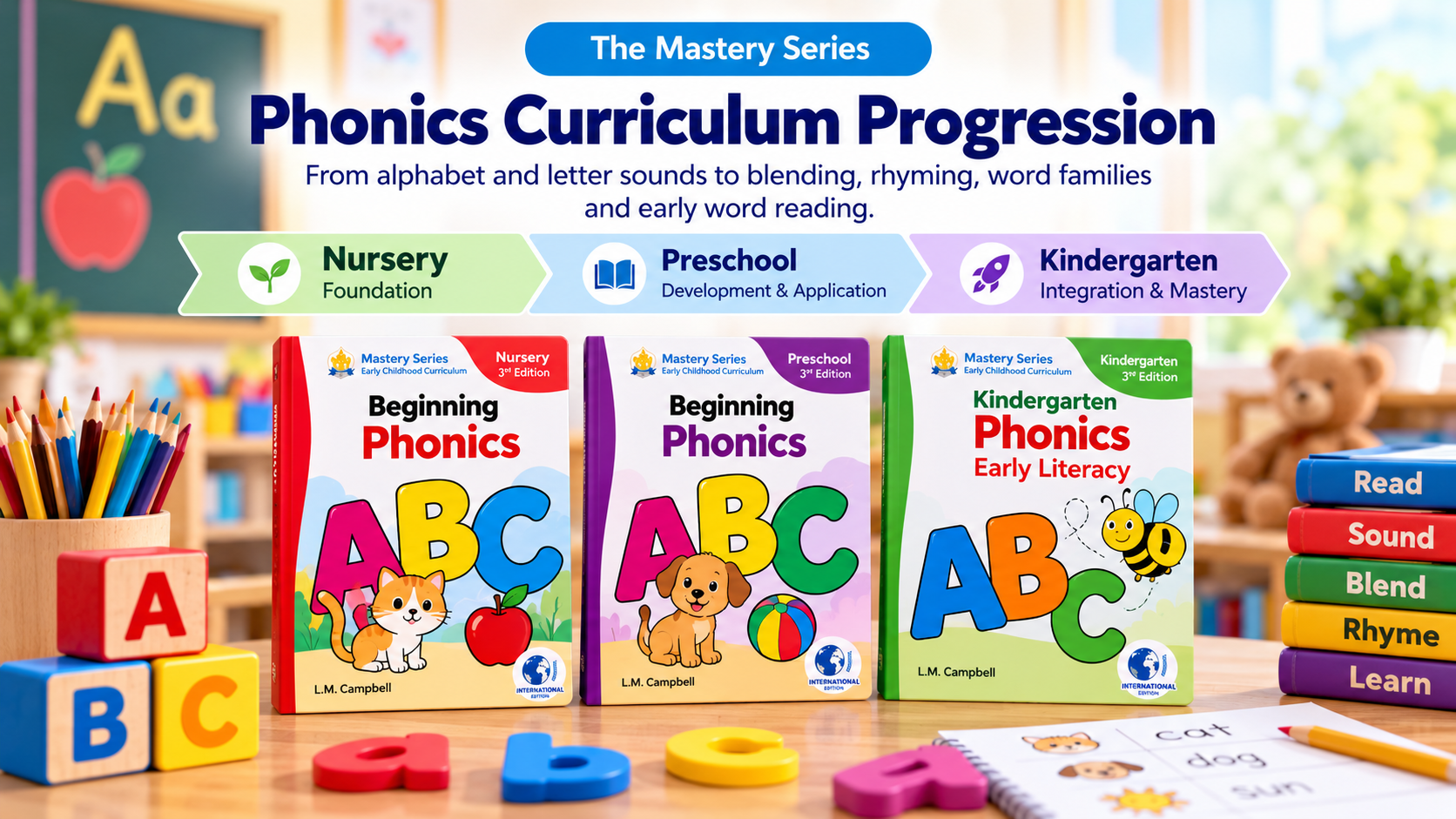
The Mastery Series • Phonics Curriculum
Mastery Series Phonics Curriculum Progression
A developmental pathway from early alphabet and sound awareness to sound analysis, blending, early word reading and writing.
The Mastery Series Phonics Curriculum from Liberty Education provides a connected early literacy pathway across Nursery, Preschool and Kindergarten.
Children begin with letters, sounds, vocabulary and oral language. They then strengthen sound discrimination, letter formation and cumulative alphabet knowledge before progressing to short vowels, beginning, middle and ending sounds, blending, rhyming, sound patterns, word families and early word reading.
Phonics Progression at a Glance
The three Phonics levels are designed to build progressively. Each stage strengthens earlier knowledge while introducing new literacy demands.
| Level | Developmental Stage | Primary Phonics Focus |
|---|---|---|
| Nursery Phonics | Foundation | Alphabet awareness, uppercase and lowercase letters, letter names, target sounds, beginning-sound vocabulary, oral language, case matching, sequencing and emerging letter formation. |
| Preschool Phonics | Development & Application | Pre-writing skills, alphabet knowledge, letter-sound relationships, beginning-sound discrimination, vocabulary, uppercase and lowercase matching, letter formation, alphabet sequence and cumulative review. |
| Kindergarten Phonics | Integration & Mastery | Beginning consonants, short vowels, middle and ending sounds, sound analysis, blending, sound patterns, rhyming, familiar simple word reading, word families, writing, sequencing and early comprehension. |
From Sounds to Early Reading
The Mastery Series Phonics pathway gradually changes what children are expected to do with letters and sounds.
At Nursery level, children primarily learn to recognize and connect. At Preschool level, they increasingly discriminate, form and apply. At Kindergarten level, children begin to analyze, blend, read and write using the sound knowledge they have developed.
Hear → Recognize → Name → Connect → Discriminate → Analyze → Blend → Read → Write → Understand
Nursery • Foundation
Nursery Phonics
Building Letter & Sound Foundations
Nursery Phonics introduces children to the alphabet through letter recognition, letter names, sounds, vocabulary, oral language, movement and emerging writing experiences.
Children encounter uppercase and lowercase letters and learn to connect target letters with familiar words that begin with the corresponding sound.
Vocabulary development is an important part of the program. Children name familiar objects, listen for target beginning sounds, discuss the characteristics of objects and use new words in meaningful oral-language contexts.
Key Nursery Phonics Learning
- alphabet awareness;
- uppercase and lowercase letter recognition;
- letter names;
- target letter sounds;
- beginning-sound vocabulary;
- uppercase and lowercase matching;
- visual and auditory attention;
- oral-language development;
- alphabet sequencing and cumulative review;
- fine-motor development; and
- emerging letter formation and writing.
Nursery Learning Pathway
Hear → Recognize → Name → Match → Say the Sound → Associate → Begin to Form
Moving from Nursery to Preschool
The transition from Nursery to Preschool moves children from introductory alphabet and sound experiences toward more structured discrimination and written application.
Children continue working with letters, sounds and vocabulary, but Preschool places greater emphasis on pre-writing control, identifying beginning sounds, matching uppercase and lowercase forms, forming letters and recalling previously learned letters in cumulative review.
Awareness → Recognition → Discrimination → Formation → Application
Preschool • Development & Application
Preschool Phonics
Strengthening Sound Discrimination & Letter Application
Preschool Phonics strengthens the connection between letters, sounds, vocabulary and writing.
The program begins with explicit pre-writing preparation. Children practice pencil grip and develop control through vertical, horizontal, slanting, zigzag, curved and circular lines before applying these fine-motor skills to letter formation.
Letter lessons then provide repeated practice with letter names, sounds, beginning-sound vocabulary, uppercase and lowercase forms and writing.
Cumulative reviews help children revisit previously introduced letters, sounds and alphabet order rather than treating each letter as an isolated lesson.
Key Preschool Phonics Learning
- pencil grip and pre-writing control;
- vertical, horizontal, slanting, zigzag, curved and circular lines;
- alphabet knowledge;
- uppercase and lowercase recognition;
- letter-sound relationships;
- beginning-sound discrimination;
- beginning-sound vocabulary;
- uppercase and lowercase matching;
- letter formation and writing;
- oral-language development;
- alphabet sequence; and
- cumulative alphabet review.
Preschool Learning Pathway
Recognize → Identify → Discriminate → Connect → Match → Form → Apply → Sequence → Review
Moving from Preschool to Kindergarten
The transition to Kindergarten marks an important change in the Phonics progression.
Earlier levels concentrate primarily on recognizing letters, connecting letters with sounds, identifying beginning sounds, building vocabulary and developing letter formation.
Kindergarten extends this foundation by asking children to listen for sounds in different positions within words. Children work with beginning consonants, middle short-vowel sounds and ending consonants.
Sound knowledge is then brought together through blending, rhyming, recurring sound patterns and familiar simple words.
Letter & Sound Knowledge → Sound Position → Sound Analysis → Blending → Word Patterns → Early Word Reading
Kindergarten • Integration & Mastery
Kindergarten Phonics
Advancing Toward Early Reading & Writing
Kindergarten Phonics builds on established alphabet and beginning-sound knowledge and extends children's attention to the internal structure of words.
Children work explicitly with the five short vowels a, e, i, o and u, identify short-vowel sounds within simple words and listen for consonant sounds at the ends of words.
The program also brings consonant and vowel sounds together through blending activities and familiar simple word reading.
Rhyming and sound-pattern activities help children recognize recurring relationships among words, leading into focused word-family activities.
Key Kindergarten Phonics Learning
- beginning consonant sounds;
- short a, e, i, o and u;
- middle short-vowel sounds;
- ending consonant sounds;
- beginning, middle and ending sound analysis;
- blending within simple word activities;
- familiar simple word reading;
- rhyming words;
- recurring sound patterns;
- word families;
- letter and word writing;
- vocabulary and simple sentences;
- sequencing; and
- early story understanding.
Kindergarten Learning Pathway
Identify → Discriminate → Analyze → Connect → Blend → Read → Write → Sequence → Understand
From Letter Sounds to Short-Vowel Words
Kindergarten introduces a significant development in the Phonics pathway: children begin applying their knowledge of consonants and vowels within complete simple words.
Short-vowel instruction includes all five vowels:
- a — short a;
- e — short e;
- i — short i;
- o — short o; and
- u — short u.
Children encounter these vowels as target sounds and as middle sounds in familiar simple words.
Teacher-guided activities also ask children to connect individual letter sounds smoothly when working with short-vowel words.
Consonant → Vowel → Sound Position → Blend → Word
From Rhyming to Word Families
Kindergarten children also begin noticing that different words can share the same ending sound.
Rhyming activities ask children to identify and match words that rhyme and to suggest additional rhyming words.
Common patterns used in Teacher Guide activities include:
- -at: cat, hat, mat, rat, sat;
- -ig: pig, dig, big, wig;
- -an: man, van, can, fan;
- -op: top, hop, pop, mop;
- -ug: bug, hug, mug, rug; and
- -in: pin, bin, tin, win.
Later word-family activities give children opportunities to read, complete, write and generate words sharing familiar patterns, including focused work with -an and -at.
Hear → Compare → Rhyme → Recognize the Pattern → Read → Write → Generate
Phonics Progression by Learning Strand
The following table shows how major literacy strands develop across the three levels.
| Learning Strand | Nursery | Preschool | Kindergarten |
|---|---|---|---|
| Alphabet Knowledge | Recognize and name uppercase and lowercase letters | Strengthen alphabet recognition, naming and sequence | Apply established letter knowledge within sound, word and writing activities |
| Letter-Sound Knowledge | Connect target letters with their sounds | Strengthen letter-sound relationships and recall | Apply consonant and vowel knowledge within simple words |
| Beginning Sounds | Associate familiar vocabulary with target beginning sounds | Identify and discriminate words by beginning sound | Develop and review beginning consonant sounds across increasingly varied vocabulary |
| Short Vowels | — | — | Explicit work with short a, e, i, o and u |
| Middle Sounds | — | — | Identify short-vowel sounds in the middle of simple words |
| Ending Sounds | — | — | Identify consonant sounds at the ends of words |
| Sound Analysis | Attend to the target letter sound | Discriminate target beginning sounds | Analyze beginning, middle and ending sound positions |
| Blending | — | — | Connect taught sounds smoothly within simple word activities |
| Rhyming | Experience rhyme through songs, stories and oral language | Continue rhyme-rich experiences through songs and classroom language | Identify, match and generate rhyming words |
| Sound Patterns | — | — | Recognize and compare recurring ending patterns |
| Early Word Reading | — | — | Read familiar simple words containing taught short-vowel sounds and patterns |
| Word Families | — | — | Read, complete and write familiar words with common ending patterns |
| Pre-Writing | Fine-motor experiences supporting emerging writing | Pencil grip and structured line-formation practice | Apply established fine-motor control to letter and word writing |
| Letter Formation | Begin tracing and forming familiar letters | Practice uppercase and lowercase letter formation | Continue letter formation while writing within word-level activities |
| Vocabulary | Build vocabulary associated with target letters | Expand beginning-sound vocabulary and word knowledge | Apply vocabulary within phonics, word and sentence activities |
| Oral Language | Discuss familiar words and use simple oral language | Use target vocabulary in phrases, sentences and discussion | Connect vocabulary with sentences, stories and early comprehension |
| Cumulative Review | Revisit letters and alphabet sequence | Review increasingly large groups of letters toward A–Z | Review consonants, vowels, sound relationships, patterns and word-level skills |
| Early Comprehension | — | — | Work with grouping, opposites, before and after, story order and story understanding |
Writing Develops Alongside Phonics
Writing is developed progressively rather than introduced as a separate skill at the end of the sequence.
Nursery
Children strengthen fine-motor control and begin tracing and forming familiar uppercase and lowercase letters.
Preschool
Children begin with structured pre-writing preparation and then practice writing uppercase and lowercase letters throughout the alphabet sequence.
Kindergarten
Children continue letter formation while increasingly using letters within familiar words, short-vowel activities, sound-pattern work and word-family activities.
Fine-Motor Control → Pre-Writing → Letter Formation → Word Completion → Familiar Word Writing
Vocabulary, Oral Language & Meaning
Vocabulary and oral language remain important throughout all three levels.
At Nursery, children discuss familiar objects and connect words with target sounds. Preschool expands these experiences through repeated beginning-sound vocabulary and simple sentence use.
Kindergarten continues vocabulary and sentence development while adding sequencing and early comprehension activities such as opposites, grouping, before and after, story order and story sense.
Name → Describe → Discuss → Use in a Sentence → Sequence → Understand
How Children Learn Phonics
Across the Mastery Series, phonics instruction is supported by active and multisensory classroom experiences.
Depending on the developmental level and lesson, children may learn through:
- teacher modeling and guided discussion;
- stories and story questions;
- songs, rhymes and action activities;
- letter and sound games;
- picture and vocabulary cards;
- matching and sorting;
- sound-discrimination activities;
- tracing and writing;
- fine- and gross-motor activities;
- rhyming and word games;
- art and craft experiences;
- sensory exploration;
- manipulatives;
- learning centers;
- guided practice; and
- Student Book application.
The Complete Mastery Series Phonics Pathway
Viewed as a complete sequence, the three Phonics programs move children from foundational alphabet experiences toward increasingly connected use of sounds within words.
Nursery Phonics
Foundation
Letters → Sounds → Beginning-Sound Vocabulary → Matching → Emerging Formation
Preschool Phonics
Development & Application
Pre-Writing → Letter-Sound Knowledge → Beginning-Sound Discrimination → Formation → Sequence → Cumulative Review
Kindergarten Phonics
Integration & Mastery
Beginning Sounds → Short Vowels → Middle Sounds → Ending Sounds → Blending → Sound Patterns → Early Word Reading → Word Families
FOUNDATION → DEVELOPMENT & APPLICATION → INTEGRATION & MASTERY
Explore the Mastery Series Curriculum
Mastery Series Scope & Sequence
Compare Mathematics and Phonics learning across Nursery, Preschool and Kindergarten in the complete curriculum overview.
View the Mastery Series Scope & Sequence →
Mathematics Curriculum Progression
Explore how Mathematics develops from early number, quantity, colors and shapes through comparison, measurement, early addition and mathematical reasoning.
Explore the Mathematics Curriculum Progression →
Mastery Series FAQ
Find answers about the curriculum levels, Teacher Guides, Student Books, developmental progression and classroom use.
Mastery Series Overview
Explore all six Mathematics and Phonics programs in the complete Mastery Series.