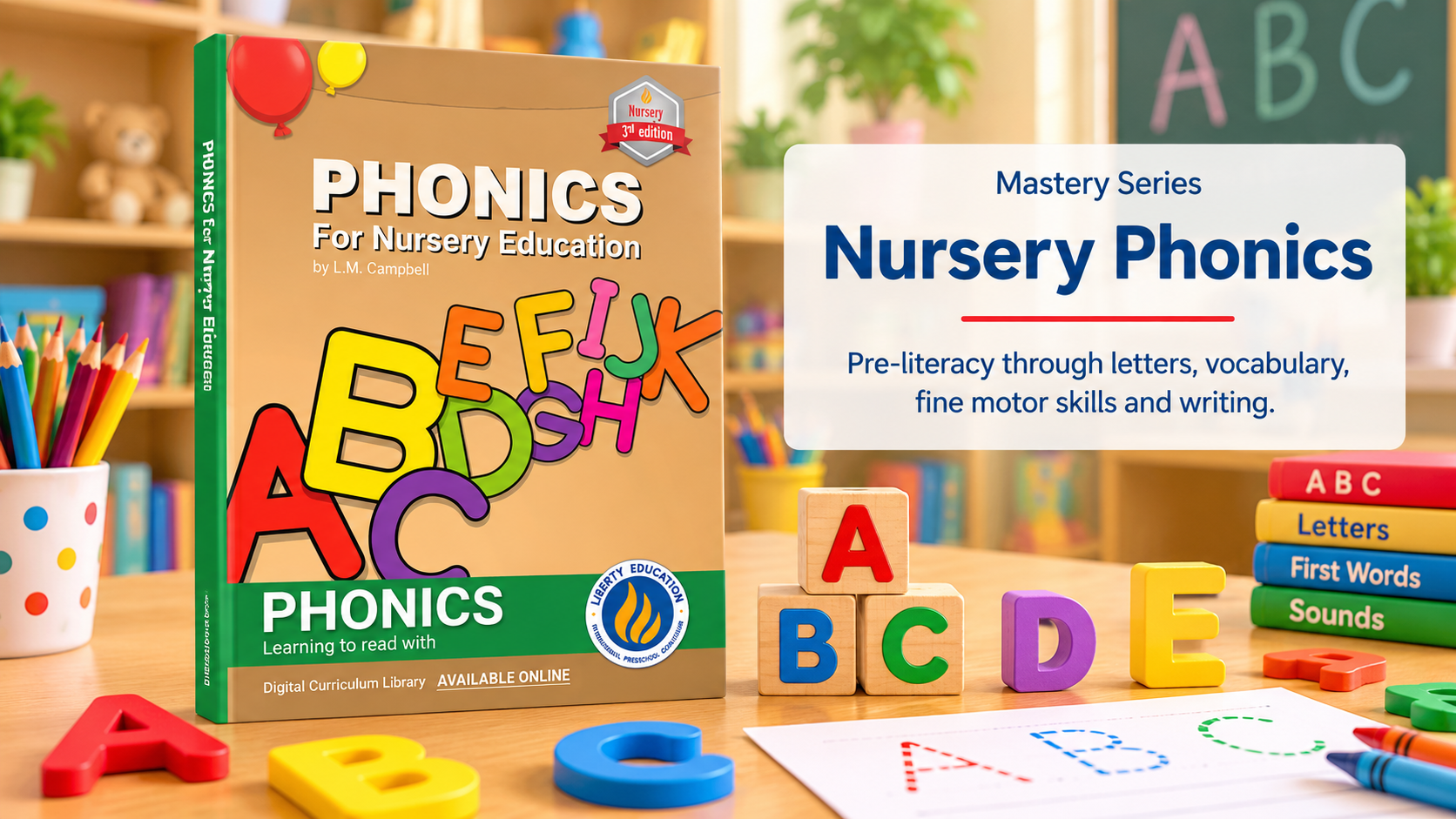
The Mastery Series • Nursery • Phonics
Nursery Phonics
Building pre-literacy foundations through letters, sounds, vocabulary, oral language, fine-motor development and emerging writing.
Building Letter & Sound Foundations
Nursery Phonics is the foundation-level Phonics program in the Mastery Series from Liberty Education. It introduces young children to letters and their sounds while developing vocabulary, oral language, visual and auditory discrimination, fine-motor control and emerging letter formation.
Children become familiar with uppercase and lowercase letters, connect letters with their target sounds, identify familiar words beginning with those sounds and build vocabulary through pictures, conversation, stories, songs, movement and classroom activities.
The program combines a structured Student Book with a detailed Teacher Guide, allowing children to experience letters and sounds through active, multisensory learning before reinforcing their understanding through guided page activities.
Nursery Phonics at a Glance
| Series | Mastery Series Early Childhood Curriculum |
|---|---|
| Level | Nursery |
| Subject | Phonics |
| Curriculum Focus | Pre-literacy |
| Alphabet | Uppercase and lowercase A–Z |
| Key Learning Areas | Letter recognition, letter sounds, beginning sounds, vocabulary, uppercase/lowercase matching, alphabet sequence, fine-motor development and emerging writing |
| Curriculum Components | Teacher Guide and Student Book |
| Author | L.M. Campbell and Liberty Education's Curriculum Development Team |
| Edition | Third Edition |
| Publisher | Liberty Education |
What Children Learn
Nursery Phonics develops early literacy foundations through connected experiences with letters, sounds, words, pictures, spoken language and emerging writing.
Alphabet Knowledge
Children become familiar with the letters of the alphabet from A through Z. They learn to recognize and name letters and encounter them repeatedly through pictures, vocabulary, tracing, games and classroom activities.
Uppercase & Lowercase Letters
Children learn that letters have uppercase and lowercase forms. Activities help them visually discriminate between letter forms and match corresponding uppercase and lowercase letters.
Letter-Sound Connections
Each letter is associated with a target sound. Children listen to, repeat and recognize the sound while connecting it with the corresponding written letter.
Beginning Sounds
Children identify familiar words and pictures that begin with the target letter sound. This helps them begin noticing that spoken words are made up of sounds and that the first sound can be connected with a letter.
Vocabulary Development
Vocabulary is developed throughout the program. Children name familiar objects and pictures, learn new words associated with each letter and use vocabulary in teacher-guided conversation and simple oral contexts.
Visual & Auditory Discrimination
Children learn to look carefully at letter forms and listen carefully to sounds. Matching, sorting, picture identification and sound-based activities help strengthen the discrimination skills that support later reading and writing.
Fine-Motor Development
Tracing, drawing, coloring, manipulating materials and letter-formation activities help strengthen hand control and coordination in preparation for increasingly independent writing.
Emerging Letter Formation
Children are introduced to forming uppercase and lowercase letters through tracing, guided writing and multisensory letter activities.
Alphabet Sequence
As children learn more letters, cumulative activities help them place familiar letters in alphabetic order and review previously introduced letter-sound relationships.
How Letter Learning Develops
Nursery Phonics does more than present one letter at a time. Children repeatedly connect the appearance of a letter with its name, sound, uppercase and lowercase forms and familiar vocabulary.
Hear → Recognize → Name → Match → Say the Sound → Connect to Words → Trace → Form → Review
A letter lesson may ask children to recognize the target letter, identify its uppercase and lowercase forms, say its sound, name pictures beginning with that sound, learn related vocabulary and practice forming the letter.
This creates a connection between letter shape, letter name, sound and spoken vocabulary rather than treating each element as an isolated skill.
Inside the Student Book
The Nursery Phonics Student Book follows a structured progression through the alphabet while regularly revisiting previously learned letters and sounds.
For many letters, the Student Book sequence includes:
- introduction to the target letter;
- uppercase and lowercase letter forms;
- words beginning with the target sound;
- picture-based vocabulary associated with the letter;
- letter recognition and matching;
- guided tracing and emerging writing;
- beginning-sound activities;
- alphabet sequencing; and
- cumulative review of previously learned letters.
The sequence begins with A and progresses through the alphabet to Z, with review activities positioned throughout the book.
Learning Through Cumulative Review
Nursery Phonics does not wait until the end of the alphabet to review earlier learning. The Student Book includes cumulative activities as children progress.
For example, after the first group of letters, children revisit beginning sounds A–D. Later, they work with sequencing A–L, and subsequent sequencing activities extend the growing alphabet range.
This repeated retrieval helps children reconnect new letters with letters they have already encountered.
Teacher-Guided Phonics Learning
The Nursery Phonics Teacher Guide expands Student Book learning into active classroom experiences involving listening, speaking, movement, visual recognition, vocabulary and fine-motor development.
Teachers introduce letters and sounds through modeling and guided interaction. Children may listen for a target sound, repeat it, identify pictures beginning with the sound, match uppercase and lowercase forms, sort pictures by beginning sound and use new vocabulary in spoken language.
Letter formation can also be explored away from the page through large-scale movement and hands-on materials before children practice tracing and writing.
How Children Learn
Nursery Phonics uses an active, multisensory approach to early literacy learning.
Depending on the lesson, children may learn through:
- teacher modeling and guided discussion;
- stories and rhymes;
- songs and action activities;
- listening and repeating target sounds;
- picture and vocabulary cards;
- uppercase and lowercase matching;
- beginning-sound sorting and classification;
- movement and large-scale letter activities;
- tracing and guided writing;
- art and craft activities;
- fine-motor experiences;
- games and manipulatives;
- learning centers; and
- Student Book practice.
Encountering letters through sight, sound, speech, movement and touch gives children multiple ways to build familiarity with early literacy concepts.
Learning Centers & Classroom Exploration
Teacher Guide activities can extend phonics learning into classroom centers where children revisit letters, sounds and vocabulary through different types of play and practice.
Depending on the lesson, these may include:
- Literacy & Language: letter recognition, picture vocabulary, sounds and oral language
- Fine Motor: tracing, drawing, letter formation, cutting, pasting and manipulation
- Art: letter crafts, drawing, coloring and picture-based activities
- Movement: forming or following large letters and participating in action activities
- Manipulatives: matching, sorting and constructing letters with hands-on materials
- Sensory Exploration: forming and exploring letters using tactile materials
- Dramatic Play & Oral Language: using vocabulary and spoken language in meaningful contexts
Phonics & Whole-Child Development
Phonics and pre-literacy are the central curriculum focus, while the learning experiences also support broader areas of early childhood development.
Language Development
Letter names, sounds, vocabulary, listening, speaking, discussion and simple oral language.
Cognitive Development
Recognition, memory, visual discrimination, auditory discrimination, matching, classification and sequencing.
Fine-Motor Development
Tracing, drawing, coloring, guided letter formation, cutting, pasting and manipulation.
Gross-Motor Development
Action songs, movement activities and large-scale experiences with letter forms.
Social & Emotional Development
Listening, participating in group activities, taking turns, responding to directions and communicating with others.
Creative Development
Art, songs, movement, stories and hands-on activities provide additional ways for children to explore letters and language.
Nursery Phonics Curriculum Sequence
The curriculum progresses through the alphabet while combining letter recognition, sounds, vocabulary, beginning-sound awareness, letter formation and cumulative review.
| Learning Area | Development |
|---|---|
| Alphabet Knowledge | Recognition and naming of letters A–Z |
| Uppercase & Lowercase | Recognizing, distinguishing and matching corresponding letter forms |
| Letter Sounds | Connecting target sounds with their corresponding letters |
| Beginning Sounds | Identifying familiar pictures and words beginning with target sounds |
| Vocabulary | Naming and discussing familiar words associated with each letter |
| Letter Formation | Tracing and beginning to form uppercase and lowercase letters |
| Alphabet Sequence | Placing increasingly larger groups of familiar letters in order |
| Cumulative Review | Revisiting previously introduced letters, sounds and vocabulary as new letters are added |
Developmental Progression
Nursery Phonics establishes the foundation of the Mastery Series Phonics pathway.
Hear → Recognize → Name → Match → Connect Sound → Build Vocabulary → Trace → Form → Review
At Nursery level, the emphasis is on building the alphabet, letter-sound, vocabulary, oral-language and letter-formation foundations that support more advanced phonics learning at later levels.
See how these foundations develop through Preschool and Kindergarten in the Mastery Series Phonics Curriculum Progression .
From Nursery to Preschool Phonics
Nursery Phonics provides the foundation for the next stage of the Mastery Series Phonics pathway.
Familiarity with letters, sounds, uppercase and lowercase forms, beginning-sound vocabulary, oral language and emerging letter formation prepares children for the stronger sound discrimination, pre-writing, letter formation and cumulative alphabet work developed in Preschool Phonics.
Scope & Sequence
Explore how Nursery Phonics fits within the complete developmental sequence of Mathematics and Phonics learning across Nursery, Preschool and Kindergarten.
Nursery Phonics FAQ
What does Nursery Phonics teach?
Nursery Phonics introduces alphabet knowledge, uppercase and lowercase letters, target letter sounds, beginning-sound vocabulary, oral language, letter formation, alphabet sequence and cumulative review.
Does Nursery Phonics cover the complete alphabet?
Yes. The Student Book progresses through the alphabet from A to Z, with uppercase and lowercase letter work, beginning-sound vocabulary and review activities throughout the sequence.
Does Nursery Phonics teach letter sounds?
Yes. Children connect letters with their target sounds and identify familiar pictures and words beginning with those sounds.
Does Nursery Phonics develop vocabulary?
Yes. Vocabulary development is a recurring part of the program. Letter sections introduce familiar words and pictures that allow children to connect new vocabulary with the target letter and sound.
Does Nursery Phonics include writing?
The program includes emerging letter formation through tracing, guided writing and fine-motor activities involving uppercase and lowercase letters.
Does Nursery Phonics teach children to read words?
Nursery Phonics primarily develops the foundations needed for later reading. The emphasis is on alphabet knowledge, letter sounds, beginning-sound awareness, vocabulary, oral language, visual and auditory discrimination and emerging letter formation.
More explicit sound blending and simple word reading are developed later in the Mastery Series Phonics progression.
Does Nursery Phonics include review?
Yes. The Student Book includes cumulative beginning-sound and alphabet sequencing activities that revisit earlier letters as children progress through the alphabet.
Is Nursery Phonics only a workbook?
No. The Student Book is supported by a Teacher Guide with active learning experiences including stories, songs, movement, vocabulary, picture activities, sound discrimination, matching, fine-motor activities, art and learning centers.
What comes after Nursery Phonics?
Nursery Phonics is followed by Preschool Phonics , where children continue developing letter-sound knowledge, sound discrimination, pre-writing skills, letter formation and cumulative alphabet understanding.