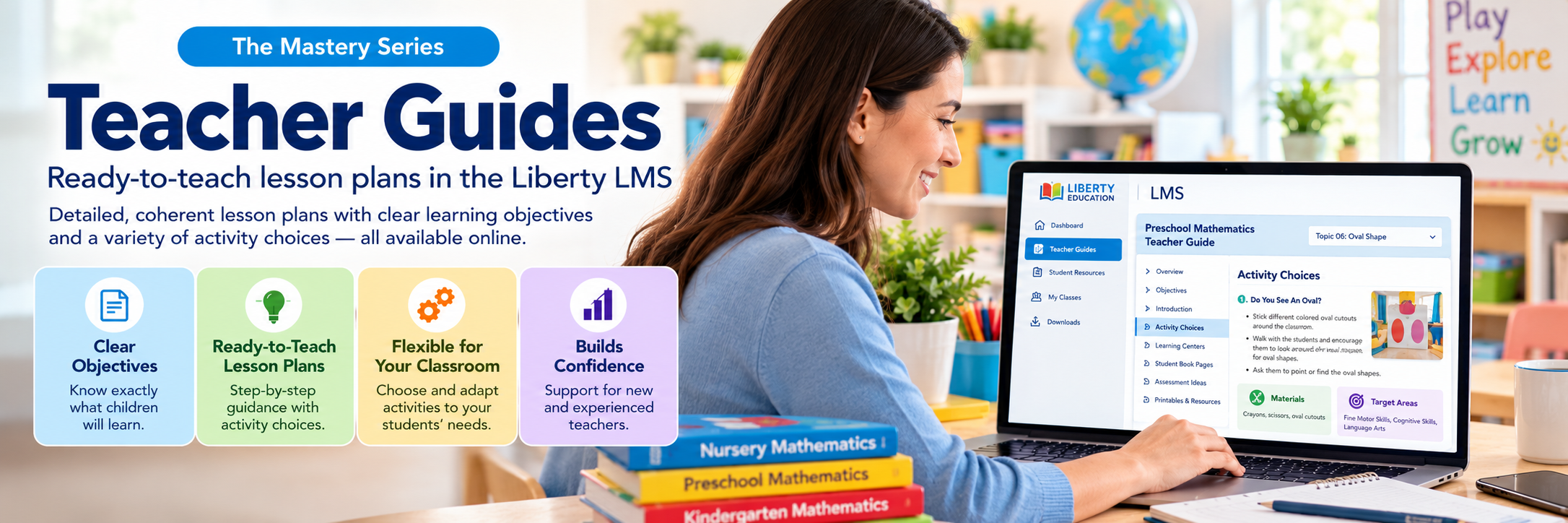
Teacher Guides — Liberty Preschool Curriculum
Ready-to-teach lesson plans. Clear objectives. Flexible classroom delivery.
A curriculum should do more than describe what children need to learn. It should help teachers understand how to teach it.
Liberty Education's Teacher Guides provide detailed, coherent, ready-to-teach lesson plans that follow the Student Books page by page. Each lesson is organized around clearly defined learning objectives and offers a selection of purposeful activities that teachers can choose from according to their students' needs, interests, abilities, and classroom circumstances.
The lesson planning is already provided. Teachers can concentrate on delivering engaging learning experiences, observing children's progress, and adapting instruction to the children in front of them.
For school owners and academic directors, the essential question is not simply whether a curriculum has good learning objectives. It is: What does the teacher actually do in the classroom to achieve them?
Liberty's Teacher Guides provide a practical answer.
What the Teacher Guides contain
Each Teacher Guide connects the learning objectives of the Student Book with detailed lesson plans and classroom activities designed to help children achieve those objectives.
Teachers are provided with:
- Clear learning objectives: Specific knowledge and skills that each lesson is designed to develop.
- Page-by-page curriculum guidance: Lesson plans connected to the relevant Student Book pages.
- Ready-to-teach lesson plans: Structured teaching guidance, introductions, suggested stories, songs, questions, and practical learning experiences.
- A choice of activities: Multiple activities addressing the same learning objectives, allowing teachers to select those most appropriate for their class.
- Materials and preparation guidance: Information to help teachers organize the resources needed for activities.
- Learning-center suggestions: Additional opportunities for exploration, practice, and reinforcement.
- Learning evaluation guidance: Opportunities to observe and assess children's progress in relation to the lesson objectives.
Teachers do not need to create every lesson from the beginning or search independently for activities that might support the curriculum.
The Teacher Guides provide the instructional foundation, including what to teach, why it matters, and practical choices for how to teach it.
An experienced teacher can build upon these lesson plans, while a teacher who is new to the curriculum can follow the guidance with confidence.
The objectives remain consistent. The choice of activities remains flexible.
Teacher Guides are available through the Liberty LMS
Liberty Teacher Guides are delivered through the online Liberty Learning Management System (LMS), giving teachers convenient access to lesson plans, curriculum guidance, and supporting resources.
Teachers can open the relevant lesson, identify the learning objectives, review the Student Book activities, and choose from the suggested teaching approaches and learning experiences.
For schools operating multiple classrooms or campuses, the LMS provides a shared instructional resource that supports curriculum consistency while allowing teachers to respond to the needs of their own students.
The digital format also supports teacher onboarding. Newly appointed teachers can access the lesson plans and understand the curriculum's instructional structure without depending entirely on another teacher to explain how each lesson should be delivered.
Access the Liberty Education LMS: https://lms.libertyeducation.co/
Why the Teacher Guides are designed this way
Consistency without restricting teachers
A coherent curriculum requires more than a common set of Student Books. Teachers also need a shared understanding of the learning objectives and the instructional experiences that support them.
Liberty's Teacher Guides provide that common foundation.
Because each lesson includes defined objectives and a choice of relevant activities, teachers can work toward consistent learning outcomes without being required to deliver every lesson in exactly the same way.
A teacher might select a movement game, a story-based activity, a manipulative exercise, or a creative project depending on the children and the resources available. Each choice supports the intended learning.
This combination of structure and flexibility helps schools maintain curriculum continuity while respecting teachers' professional judgment.
Ready-to-teach does not mean one-size-fits-all
The Teacher Guides are designed to reduce unnecessary lesson-planning work, not to remove teacher creativity.
A lesson may include several suggested activities, allowing teachers to select, combine, extend, or adapt them while maintaining the central learning objectives.
This is particularly valuable in early childhood classrooms, where children develop at different rates and respond to different approaches.
Teachers have the freedom to choose how they engage their students while working within a coherent curriculum sequence.
Liberty provides the lesson plans and learning objectives. Teachers make informed choices about classroom delivery.
Designed for real international classrooms
International preschool classrooms often include children with different home languages, levels of readiness, and previous learning experiences.
Teachers may also come from different educational backgrounds and have varying levels of experience with early childhood education.
Liberty's Teacher Guides support these environments by offering clearly structured lesson plans with a range of activity choices.
Teachers can select and adapt activities according to language needs, available materials, class size, student readiness, and teaching time while maintaining the lesson's educational purpose.
Supporting different teaching approaches
Liberty Education provides a structured academic curriculum that schools can integrate with their existing early childhood philosophy and classroom practices.
Schools using play-based learning, inquiry, Montessori-inspired activities, Reggio-inspired experiences, or other approaches can select and adapt appropriate activities from the Teacher Guides.
The curriculum establishes the learning sequence and objectives. The school and its teachers determine how those objectives are best addressed within their educational environment.
Structure provides continuity. Flexibility allows meaningful teaching.
Who benefits from the Teacher Guides?
School owners and academic directors
The Teacher Guides provide a consistent instructional foundation across classrooms, helping school leaders support curriculum implementation, teacher development, and onboarding.
The detailed lesson plans also make it easier to understand how Student Book content is translated into purposeful classroom learning.
Classroom teachers
Teachers receive ready-to-teach lesson plans rather than a list of objectives without implementation guidance.
They can choose from suggested activities, prepare the necessary materials, and adapt the lesson according to their students' needs.
This reduces the time spent searching for teaching ideas and allows more attention to be given to teaching, observation, and student engagement.
Homeschooling parents
Parents using the curriculum at home can also benefit from the step-by-step guidance and suggested activities.
The Teacher Guides explain the purpose of each lesson and provide practical ways to support learning without requiring parents to develop their own lesson plans from scratch.
Student Books provide the progression. Teacher Guides provide the lesson plans.
The Liberty Student Books establish the sequence of learning across Nursery, Preschool, and Kindergarten Mathematics and Phonics.
The Teacher Guides translate that sequence into coherent, ready-to-teach lesson plans, with clear objectives and a variety of activities designed to achieve them.
Together, they provide a curriculum that is structured enough to support consistent implementation and flexible enough to accommodate different teachers, children, classrooms, and school approaches.
Teachers are not left to work out how to deliver the curriculum on their own. They are provided with practical teaching guidance and meaningful choices for bringing each lesson to life.
Explore the Liberty Teacher Guides
Discover how the Teacher Guides connect Student Book learning objectives with detailed lesson plans, classroom activities, and supporting resources through the Liberty Learning Management System.
Preview the Liberty Education LMS: https://lms.libertyeducation.co/