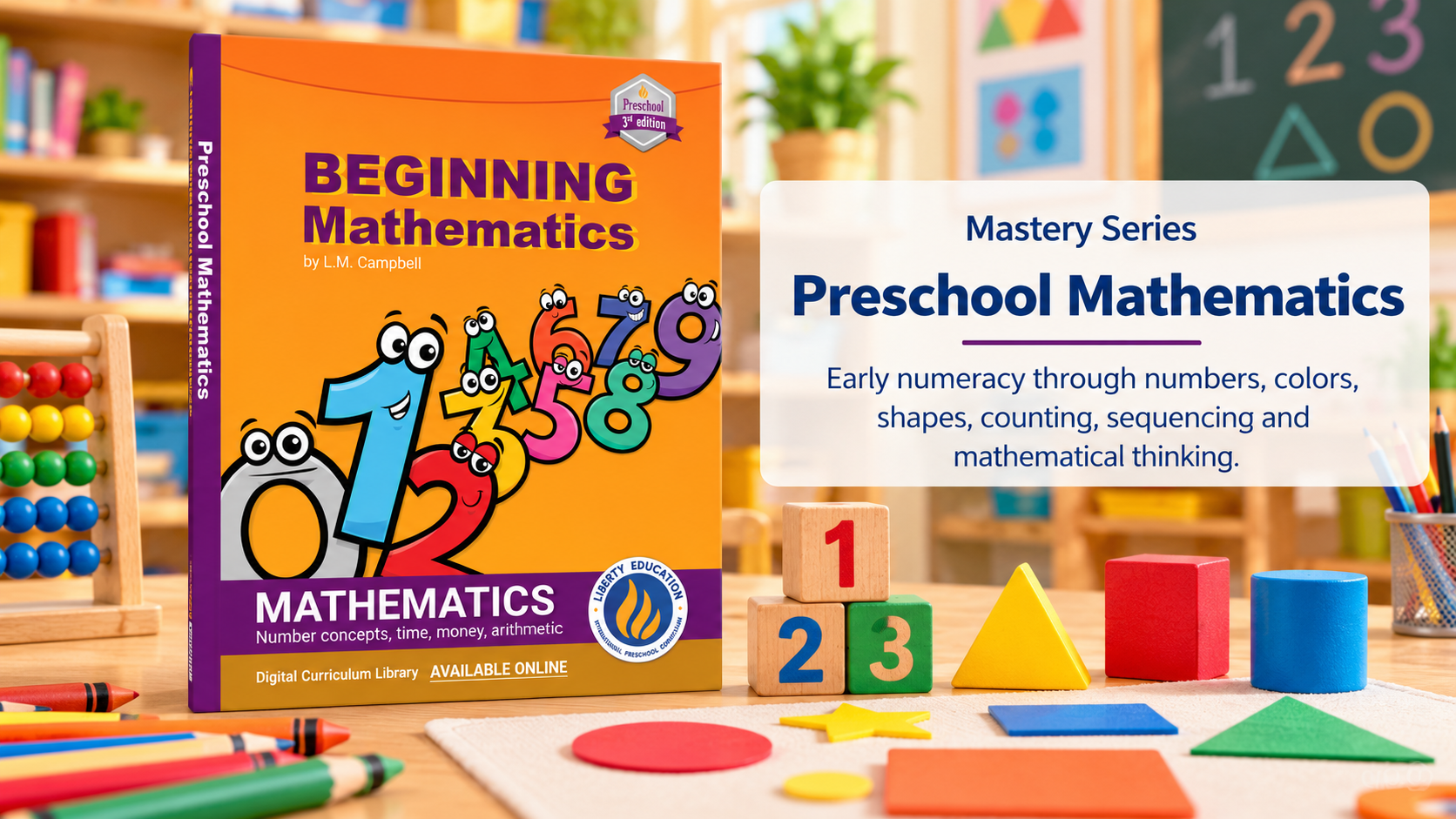
The Mastery Series • Preschool • Mathematics
Preschool Mathematics
Developing early numeracy through numbers, quantities, colors, shapes, counting, sequencing, sorting and mathematical thinking.
Developing Early Mathematical Understanding
Preschool Mathematics is the second Mathematics level in the Mastery Series from Liberty Education. It builds on children's early mathematical experiences and develops stronger understanding of numbers, quantities, colors, shapes, sequencing, classification and mathematical relationships.
Children work with numbers from 0 through 10 and connect numerals with number names, written number words and quantities. They also explore colors, geometric shapes, sorting, matching, positional concepts and sequences through visual, hands-on and teacher-guided activities.
The program combines a structured Student Book with a detailed Teacher Guide so mathematical concepts can be introduced through active experiences and then reinforced through guided practice, discussion and Student Book application.
Preschool Mathematics at a Glance
| Series | Mastery Series Early Childhood Curriculum |
|---|---|
| Level | Preschool |
| Subject | Mathematics |
| Curriculum Focus | Early Numeracy |
| Core Number Range | Numbers 0–10 |
| Key Learning Areas | Numbers, quantities, number words, counting, colors, shapes, matching, sorting, classification, sequencing, positional concepts and early mathematical reasoning |
| Curriculum Components | Teacher Guide and Student Book |
| Author | L.M. Campbell and Liberty Education's Curriculum Development Team |
| Edition | Third Edition |
| Publisher | Liberty Education |
What Children Learn
Preschool Mathematics develops children's ability to recognize, represent, organize and apply early mathematical ideas.
Numbers 0–10
Children develop familiarity with numbers from 0 through 10. They recognize numerals, say number names, connect numerals with quantities and work with written number words.
Counting & Quantity
Children count objects and pictures, create sets containing a specified number of objects and identify the quantity represented by a numeral.
Activities repeatedly connect the spoken number, written numeral and corresponding quantity.
Number Words
Number words are introduced alongside numerals and quantities. Children encounter written number names, match number words with numerals and sets, and progressively become familiar with different ways of representing the same number.
Numeral Formation
Children trace and write numerals through guided activities that strengthen number recognition while developing fine-motor control and early mathematical recording.
Number Sequence
Children learn to arrange and follow numbers in order. Sequencing activities first work with smaller number ranges and later extend across the numbers learned in the program.
Colors
Children identify, name, differentiate, match and apply colors in pictures, objects, art and classroom experiences.
Color learning includes red, blue, yellow, green, orange, purple, brown, black, white and pink, together with cumulative color review.
Shapes
Children identify and work with familiar geometric shapes through tracing, cutting, pasting, matching, drawing, sorting and classroom exploration.
Shapes include circle, triangle, square, diamond, oval, rectangle, star and heart.
Matching, Sorting & Classification
Children compare objects and pictures and organize them according to shared attributes such as number, color and shape.
These activities strengthen children's ability to notice similarities, differences and relationships.
Position & Spatial Language
The Student Book introduces positional and directional concepts through activities involving relationships such as over and under, up and down, left to right, outside and inside.
Sequencing & Patterns
Children develop sequencing skills through number order, first-and-last activities and visual sequences. The Student Book also includes simple patterning activities in which children recognize, continue, draw and color visual patterns.
How Number Learning Develops
Preschool Mathematics strengthens the relationship between a number and the different ways that number can be represented.
Recognize → Count → Match → Quantify → Trace → Write → Sequence → Apply → Review
Children may recognize a numeral, say its name, trace and write it, count a corresponding set of objects, match it with a written number word and use it in sorting, sequencing or movement activities.
Repeatedly connecting number name, numeral, number word and quantity helps children develop increasingly flexible number understanding.
Inside the Student Book
The Preschool Mathematics Student Book provides a structured sequence of early numeracy activities extending from foundational concepts through cumulative review.
Children encounter activities such as:
- recognizing numbers 0–10;
- tracing and writing numerals;
- matching numerals with written number names;
- counting and coloring specified quantities;
- quantifying numbers;
- sequencing numbers in order;
- identifying and applying colors;
- reading familiar color names;
- recognizing, tracing and working with shapes;
- cutting and pasting shapes;
- matching colors and shapes;
- sorting and categorizing;
- identifying same and different;
- working with positional concepts;
- continuing simple visual patterns;
- using left-to-right orientation;
- completing visual sequencing activities; and
- reviewing numbers, colors, quantities and shapes.
The later portion of the book places particular emphasis on review, allowing children to bring previously learned mathematical concepts together rather than encountering them only as isolated lessons.
Mathematics Connected to the Child's World
Preschool Mathematics also includes activities that connect early mathematical thinking with familiar experiences and other areas of development.
Children encounter topics such as animals and their homes, the senses, day and night, colors of the rainbow and familiar objects while practicing observation, matching, categorization, position, color, shape and quantity.
These experiences allow mathematical vocabulary and reasoning to develop within meaningful contexts rather than only through abstract symbols.
Teacher-Guided Mathematical Learning
The Preschool Mathematics Teacher Guide expands Student Book concepts into active classroom experiences involving manipulatives, movement, discussion, songs, stories, art, games and exploration.
Number activities may involve counting classroom objects, matching numeral cards with sets, building quantities with manipulatives, arranging number cards in sequence, using number words and performing movements a specified number of times.
Shape activities may involve classroom shape hunts, sorting, tracing shapes in sensory materials, constructing pictures from geometric forms, counting sides and matching shapes with familiar objects.
Color activities extend into art, observation, sorting and sensory experiences. Children can also explore color mixing and use familiar objects to recognize and classify colors.
How Children Learn
Preschool Mathematics uses an active, multisensory approach that combines mathematical language and representation with concrete experiences.
Depending on the lesson, children may learn through:
- teacher modeling and guided discussion;
- counting real objects and manipulatives;
- number and picture cards;
- sorting and classification activities;
- matching games;
- stories, songs and rhymes;
- movement and number games;
- shape hunts and classroom exploration;
- art, cutting, pasting and construction;
- sensory activities;
- STEAM-related exploration;
- fine-motor activities;
- learning centers; and
- Student Book practice.
Learning Centers & Classroom Exploration
Teacher Guide activities extend mathematical learning into classroom centers where children can revisit concepts through hands-on practice.
Depending on the lesson, these may include:
- Mathematics: counting, quantities, number recognition, matching and sequencing
- Counting & Sorting: grouping manipulatives by number, color, shape or size
- Writing: tracing and writing numerals and number words
- Art: shape pictures, collage, color activities, cutting and pasting
- Movement: counting actions, number paths, shape games and movement sequences
- Fine Motor: tracing, drawing, writing, cutting, pasting and manipulating objects
- STEAM & Science: observing colors, shapes, objects and relationships
- Sensory Exploration: tracing shapes and exploring concepts through tactile materials
- Manipulatives: building quantities and sorting, matching or grouping concrete objects
Mathematics & Whole-Child Development
Mathematics is the central curriculum focus, while Preschool Mathematics also engages broader areas of early childhood development.
Cognitive Development
Counting, quantifying, matching, sorting, classification, sequencing, visual discrimination and early problem solving.
Language Development
Number words, color and shape vocabulary, positional language, listening, discussion and explaining mathematical observations.
Fine-Motor Development
Tracing, numeral formation, drawing, coloring, cutting, pasting and manipulating classroom materials.
Gross-Motor Development
Number paths, movement games, shape activities and counting through physical actions.
Social & Emotional Development
Participating in group games, cooperating, taking turns, following directions and solving problems with classmates.
STEAM Connections
Exploring number, color, shape, classification and relationships through observation, construction, art and hands-on investigation.
Preschool Mathematics Curriculum Sequence
Preschool Mathematics combines number development with colors, shapes, classification, sequencing and visual-spatial concepts. Cumulative review brings these areas together throughout the program.
| Learning Area | Development |
|---|---|
| Numbers 0–10 | Number recognition, names, quantities, counting and numeral formation |
| Number Words | Connecting written number names with numerals and quantities |
| Sequencing | Arranging numbers in order and following numerical sequences |
| Colors | Recognition, naming, matching, reading familiar color names and application |
| Shapes | Recognition, naming, tracing, matching, cutting, pasting and identification in familiar objects |
| Sorting & Classification | Grouping and categorizing according to shared attributes |
| Same & Different | Comparing visual information and identifying similarities and differences |
| Position & Orientation | Developing understanding of spatial and directional relationships |
| Simple Patterns | Recognizing and continuing visual sequences and patterns |
| Review & Application | Integrating numbers, quantities, colors and shapes through cumulative activities and games |
Developmental Progression
Preschool Mathematics is the development-and-application stage of the Mastery Series Mathematics pathway.
Recognize → Identify → Count → Match → Sort → Classify → Sequence → Represent → Apply
Children move from recognizing individual mathematical concepts toward representing, organizing and applying those concepts in increasingly varied activities.
See how this learning develops from Nursery through Kindergarten in the Mastery Series Mathematics Curriculum Progression .
From Preschool to Kindergarten Mathematics
Preschool Mathematics builds on the foundations established in Nursery Mathematics and prepares children for the increasingly advanced mathematical work of Kindergarten.
Experience with numbers 0–10, quantities, number words, sequencing, shapes, colors, sorting, classification and spatial relationships provides a base for the expanded number range, comparison, patterns, measurement, early addition, ordinal numbers, time, money and mathematical reasoning introduced at Kindergarten level.
Scope & Sequence
Explore how Preschool Mathematics fits within the complete developmental sequence of Mathematics and Phonics learning across Nursery, Preschool and Kindergarten.
Preschool Mathematics FAQ
What does Preschool Mathematics teach?
Preschool Mathematics develops early numeracy through numbers 0–10, counting, quantities, number words, numeral formation, colors, shapes, sorting, classification, sequencing, positional concepts and cumulative mathematical review.
What number range is taught?
The core number sequence covers 0 through 10. Children recognize numbers, count and quantify sets, trace and write numerals, work with number words and place numbers in sequence.
Does Preschool Mathematics teach number words?
Yes. Children encounter written number names and connect them with the corresponding numerals and quantities.
What shapes are included?
Children work with shapes including circles, triangles, squares, diamonds, ovals, rectangles, stars and hearts through recognition, tracing, cutting, pasting, matching, drawing and classification.
Does Preschool Mathematics teach colors?
Yes. Color recognition and application are recurring parts of the program. Children identify, match and use familiar colors and later review color names and colors in integrated activities.
Does Preschool Mathematics include sorting and classification?
Yes. Children sort and categorize objects and visual information according to attributes such as number, color and shape and develop their ability to identify similarities and differences.
Does Preschool Mathematics include spatial concepts?
Yes. The Student Book includes directional and positional experiences involving concepts such as over and under, up and down, left to right, and outside and inside.
Does Preschool Mathematics include patterns?
Yes. The Student Book includes simple visual pattern activities in which children identify, continue, draw or color a sequence.
Is Preschool Mathematics only a workbook?
No. The Student Book is supported by a Teacher Guide that expands mathematical concepts through stories, songs, movement, manipulatives, games, sorting, art, sensory experiences, STEAM connections and classroom learning centers.
What comes after Preschool Mathematics?
Preschool Mathematics is followed by Kindergarten Mathematics , where children extend their number knowledge and encounter concepts including comparison, patterns, measurement, early addition, ordinal numbers, time, money and mathematical reasoning.