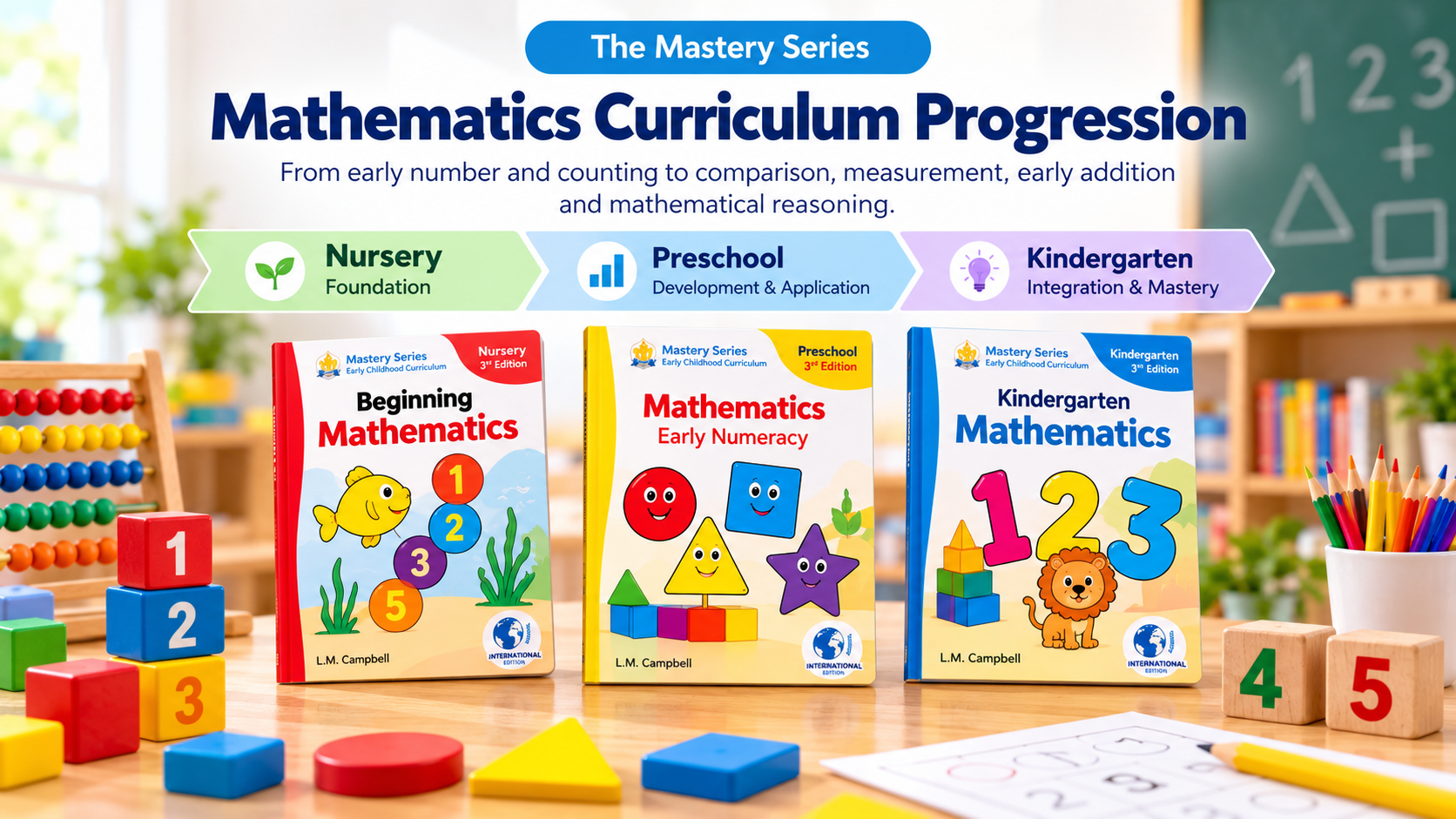
The Mastery Series • Mathematics Curriculum
Mastery Series Mathematics Curriculum Progression
A developmental pathway from early number, counting, colors and shapes to comparison, measurement, early addition and mathematical reasoning.
The Mastery Series Mathematics Curriculum from Liberty Education provides a connected early mathematics pathway across Nursery, Preschool and Kindergarten.
Children begin with concrete experiences involving numbers, quantities, colors and shapes. They then strengthen number representation, sequencing, sorting and classification before progressing to number relationships, patterns, comparison, measurement, ordinal numbers, time, money, early addition and mathematical reasoning.
Mathematics Progression at a Glance
Each Mathematics level builds on earlier learning while increasing the complexity of the concepts children are asked to recognize, represent, compare and apply.
| Level | Developmental Stage | Primary Mathematics Focus |
|---|---|---|
| Nursery Mathematics | Foundation | Numbers 1–10, numeral recognition, counting, quantities, number words, colors, shapes, matching, classification, sequencing and early mathematical language. |
| Preschool Mathematics | Development & Application | Numbers 0–10, quantities, number words, numeral representation, sequencing, colors, geometry, sorting, classification, spatial concepts and integrated mathematical review. |
| Kindergarten Mathematics | Integration & Mastery | Numbers 0–20, number order, comparison, patterns, geometry, spatial awareness, measurement, ordinal numbers, telling time, money, early addition and mathematical reasoning, with extended counting practice to 100. |
From Concrete Experiences to Mathematical Reasoning
The Mastery Series Mathematics pathway gradually changes what children are expected to do with mathematical ideas.
At Nursery level, children primarily experience, recognize, name, match and count. Preschool strengthens these foundations through representation, sequencing, sorting and classification. Kindergarten then asks children to make increasingly complex connections through comparison, measurement, early addition and reasoning.
Experience → Recognize → Count → Match → Represent → Sequence → Compare → Measure → Add → Apply → Reason
Nursery • Foundation
Nursery Mathematics
Building Early Mathematical Foundations
Nursery Mathematics introduces children to mathematics through concrete, visual and language-rich experiences with numbers, quantities, colors and shapes.
Number learning develops through recognition, counting, number words, numeral formation and connections between numerals and quantities. Children work progressively with numbers through 10.
Colors and shapes provide additional opportunities for recognition, naming, matching and classification, while sequencing activities help children begin understanding mathematical order.
Key Nursery Mathematics Learning
- numbers 1–10;
- numeral recognition;
- counting objects and quantities;
- number words;
- numeral tracing and emerging writing;
- colors and color names;
- familiar shapes;
- matching;
- classification;
- number sequencing;
- early number-line experiences; and
- mathematical vocabulary and oral language.
Nursery Learning Pathway
Experience → Explore → Recognize → Name → Match → Count → Trace → Respond
Moving from Nursery to Preschool
The transition from Nursery to Preschool moves children from introductory mathematical experiences toward more structured representation and application.
Preschool introduces zero within the core number sequence and continues number development through 10. Children make stronger connections among numerals, number words, quantities and groups of objects.
Sorting, classification, geometry and sequencing also become increasingly integrated with number learning.
Recognition → Counting → Matching → Sorting → Classification → Sequencing → Representation → Application
Preschool • Development & Application
Preschool Mathematics
Developing Mathematical Understanding & Application
Preschool Mathematics develops stronger connections among numbers, quantities, number words, colors, shapes and spatial relationships.
Children work with numbers 0–10 through counting, quantifying, tracing, writing and matching. Number words are connected with numerals and sets of objects so that children encounter multiple representations of the same mathematical idea.
Geometry, colors, sorting and classification provide additional opportunities to identify relationships, notice similarities and differences, and organize mathematical information.
Sequencing and cumulative review help children bring individual concepts together rather than treating them as isolated skills.
Key Preschool Mathematics Learning
- numbers 0–10;
- numeral recognition and writing;
- counting and quantifying;
- number words;
- matching numerals, words and quantities;
- number sequencing;
- colors and color identification;
- shapes and geometry;
- shape characteristics;
- sorting and classification;
- spatial concepts and orientation;
- visual discrimination; and
- integrated mathematical review.
Preschool Learning Pathway
Recognize → Count → Match → Sort → Classify → Sequence → Represent → Apply
Moving from Preschool to Kindergarten
Kindergarten expands both the range of numbers children work with and the types of mathematical relationships they investigate.
The core number sequence extends through 20. Children continue counting, recognizing, representing and ordering numbers while also working more explicitly with comparison, patterns, measurement and spatial relationships.
New applications include ordinal numbers, telling time, money and early addition. Mathematical tasks increasingly ask children to observe, compare, classify, solve problems and explain relationships.
Number Knowledge → Order → Comparison → Pattern → Measurement → Addition → Reasoning
Kindergarten • Integration & Mastery
Kindergarten Mathematics
Extending Mathematical Thinking & Reasoning
Kindergarten Mathematics builds on established early number knowledge and introduces increasingly connected mathematical thinking.
Numbers 0–20 form the core number sequence. Children recognize, read, write, quantify and order these numbers, while later review activities extend counting practice to 100.
Children also compare quantities and attributes, continue patterns, work with shapes and spatial relationships, measure length using centimeters and a ruler, and use ordinal language from first through fifth.
Practical mathematical applications include telling time to the hour, introductory work with money and explicit early addition using objects, counters, number sentences and mathematical symbols.
Key Kindergarten Mathematics Learning
- numbers 0–20;
- number words and quantities;
- number recognition and writing;
- number order and sequencing;
- extended counting practice to 100;
- comparison and more-or-less relationships;
- patterns;
- geometry and shape recognition;
- sorting and classification;
- spatial awareness;
- measurement in centimeters;
- measuring with a ruler;
- ordinal numbers from first through fifth;
- telling time to the hour;
- calendar experiences;
- money and simple coin relationships;
- early addition;
- visual perception and discrimination;
- logical thinking; and
- mathematical problem solving.
Kindergarten Learning Pathway
Represent → Sequence → Compare → Classify → Measure → Add → Apply → Reason → Record
Number Development Across the Series
Number knowledge develops progressively across all three Mathematics programs.
Nursery: Numbers 1–10
Children begin by recognizing numerals, saying number names, counting objects, connecting quantities with numerals and beginning to trace and form numbers.
Preschool: Numbers 0–10
Preschool strengthens these relationships by explicitly including zero and connecting numerals, quantities and written number words through matching, counting, writing and sequencing activities.
Kindergarten: Numbers 0–20
Kindergarten extends the core number sequence through 20. Children read, write, quantify, compare and order numbers while applying number knowledge to increasingly complex mathematical tasks.
Later Kindergarten review also provides extended counting practice to 100. This extends the child's counting experience while the core written number sequence remains focused on 0–20.
1–10 → 0–10 → 0–20 → Extended Counting to 100
Geometry, Shape & Spatial Development
Shape learning begins with recognition and naming and develops toward identifying properties, comparing shapes and using geometry within broader mathematical activities.
Nursery children recognize and name familiar shapes. Preschool children continue identifying and matching shapes while exploring characteristics such as the number of sides.
Kindergarten extends this learning through shape recognition, drawing, classification, pattern activities and spatial-awareness tasks involving position, direction and relationships.
Recognize → Name → Match → Identify Properties → Classify → Draw → Apply
From Comparison to Measurement & Early Addition
Kindergarten introduces more formal mathematical applications after children have established early number, quantity, sequencing and classification skills.
Children compare objects and quantities using relationships such as more and less and attributes such as size, height and length.
Measurement activities then introduce centimeters and the use of a ruler, helping children connect comparison with numerical measurement.
Early addition introduces the idea of combining quantities. Children use concrete materials and pictures before recording answers within simple number sentences.
They are introduced to the plus sign (+), the equals sign (=) and the concept of a sum.
Compare → Measure → Quantify → Combine → Add → Record
Mathematics in Everyday Contexts
Kindergarten also extends mathematical learning into familiar everyday contexts.
Ordinal Numbers
Children learn ordered position from first through fifth and apply ordinal language to pictures, objects, games and movement activities.
Time
Children are introduced to telling time to the hour and connect time concepts with classroom activities.
Calendar
Calendar activities provide opportunities to discuss the day and date and review the days of the week and months of the year.
Money
Children explore coins through hands-on activities and introductory coin relationships.
These experiences help connect mathematical ideas with familiar situations beyond isolated number exercises.
Mathematics Progression by Learning Strand
The following table shows how major Mathematics strands develop across Nursery, Preschool and Kindergarten.
| Learning Strand | Nursery | Preschool | Kindergarten |
|---|---|---|---|
| Core Number Development | Numbers 1–10 | Numbers 0–10 | Numbers 0–20, with extended counting practice to 100 |
| Counting & Quantity | Count objects and connect numerals with quantities | Count, quantify and match numbers with sets of objects | Count and quantify increasingly larger sets and apply quantity knowledge to comparison and addition |
| Numeral Formation | Trace and begin writing numerals | Trace, write and represent numbers | Write numbers and use numerals within varied mathematical activities |
| Number Words | Connect familiar number words with numerals | Read and connect number words with numerals and quantities | Connect spoken number names, numerals, written number words and quantities |
| Sequence & Order | Sequence numbers through 10 | Sequence numbers and arrange numbered objects in order | Order numbers, identify missing numbers and complete number sequences |
| Colors | Recognize, name and match familiar colors | Recognize, match and apply color knowledge | Reinforce color recognition within integrated number and classification activities |
| Shapes & Geometry | Recognize and name familiar shapes | Identify, match and classify shapes and explore shape characteristics | Recognize, identify, draw and classify shapes within increasingly complex activities |
| Sorting & Classification | Early matching and classification experiences | Sort and classify objects, colors, shapes and mathematical representations | Apply classification within visual, logical and mathematical tasks |
| Spatial Concepts | — | Orientation and positional experiences, including left-to-right work | Left and right, top and bottom, orientation and spatial relationships |
| Comparison | — | — | Compare numbers, sets, size, height and length; explore more-or-less relationships |
| Patterns | — | — | Observe, recognize and continue patterns |
| Measurement | — | — | Measure in centimeters and use a ruler |
| Ordinal Numbers | — | — | First through fifth |
| Time & Calendar | — | — | Tell time to the hour; work with days, dates, days of the week and months |
| Money | — | — | Explore coins and introductory coin relationships |
| Early Addition | — | — | Combine quantities using counters, pictures, number sentences and addition symbols |
| Mathematical Reasoning | Matching, sequencing and early classification | Sorting, classification, integrated number-and-shape activities and problem-solving experiences | Visual perception, logical thinking, comparison, classification, noticing details and problem solving |
Developing Mathematical Thinking
Mathematical development across the Mastery Series involves more than learning to recognize and write numbers.
Nursery children begin by noticing similarities, differences, quantities, colors, shapes and order.
Preschool children increasingly sort, classify, sequence and connect different representations of mathematical ideas.
Kindergarten extends these experiences through visual perception, comparison, logical thinking, spatial awareness, measurement, early addition and problem solving.
Notice → Match → Sort → Classify → Sequence → Compare → Solve → Reason
How Children Learn Mathematics
Across the Mastery Series, mathematics is supported through active, visual, language-rich and hands-on classroom experiences.
Depending on the developmental level and mathematical concept, children may learn through:
- teacher modeling and guided discussion;
- counting real objects;
- number cards and number words;
- manipulatives and counters;
- matching and sorting;
- classification activities;
- number and shape games;
- stories, rhymes and songs;
- movement and action activities;
- tracing, drawing and writing;
- art and craft experiences;
- sensory exploration;
- STEAM activities;
- learning centers;
- guided practice; and
- Student Book application.
The Complete Mastery Series Mathematics Pathway
Viewed as a complete sequence, the three Mathematics programs move children from foundational number experiences toward increasingly connected mathematical application and reasoning.
Nursery Mathematics
Foundation
Numbers → Counting → Quantities → Colors → Shapes → Matching → Sequencing
Preschool Mathematics
Development & Application
Number & Quantity → Representation → Number Words → Sorting → Classification → Geometry → Sequencing → Application
Kindergarten Mathematics
Integration & Mastery
Number Order → Comparison → Patterns → Geometry → Measurement → Ordinal Numbers → Time → Money → Early Addition → Reasoning
FOUNDATION → DEVELOPMENT & APPLICATION → INTEGRATION & MASTERY
Explore the Mastery Series Curriculum
Mastery Series Scope & Sequence
Compare Mathematics and Phonics learning across Nursery, Preschool and Kindergarten in the complete curriculum overview.
View the Mastery Series Scope & Sequence →
Phonics Curriculum Progression
Explore how early literacy develops from alphabet and letter-sound foundations through sound discrimination, short vowels, blending, rhyming, word families and early word reading.
Explore the Phonics Curriculum Progression →
Mastery Series FAQ
Find answers about curriculum levels, subjects, Teacher Guides, Student Books, developmental progression and classroom use.
Mastery Series Overview
Explore all six Mathematics and Phonics programs in the complete Mastery Series.