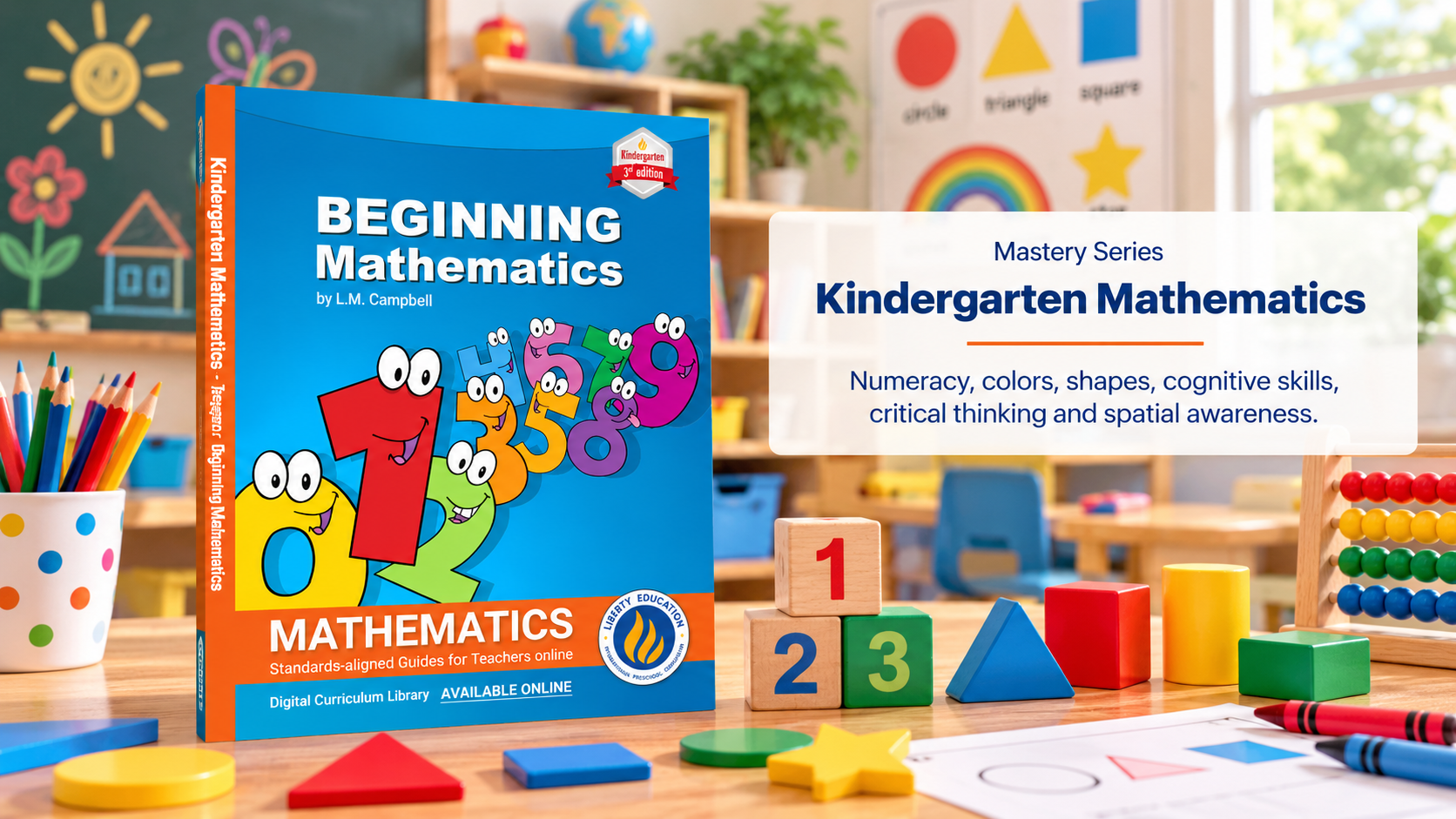
The Mastery Series • Kindergarten • Mathematics
Kindergarten Mathematics
Advancing early mathematics through numeracy, patterns, comparison, measurement, addition, time, money, spatial awareness and mathematical reasoning.
Extending Mathematical Thinking & Reasoning
Kindergarten Mathematics is the third Mathematics level in the Mastery Series from Liberty Education. It builds on the number, quantity, shape, color, sorting and sequencing foundations developed at Nursery and Preschool and extends children's learning into increasingly advanced mathematical thinking.
Children develop their understanding of numbers through 20 while working with number recognition, number words, quantities, number order and comparison. They also explore patterns, geometry, measurement, ordinal numbers, telling time, money and introductory addition.
Mathematics is integrated with visual perception, spatial awareness, classification, observation, fine-motor development and logical thinking, encouraging children not only to identify mathematical concepts but also to compare, organize, apply and reason with them.
The program combines a structured Student Book with a detailed Teacher Guide that expands mathematical concepts through manipulatives, movement, games, discussion, real objects, measurement, classroom exploration and hands-on learning.
Kindergarten Mathematics at a Glance
| Series | Mastery Series Early Childhood Curriculum |
|---|---|
| Level | Kindergarten |
| Subject | Mathematics |
| Core Number Range | Numbers 0–20 |
| Extended Counting | Counting practice to 100 |
| Key Learning Areas | Numeracy, number order, comparison, patterns, geometry, measurement, ordinal numbers, time, money, early addition, spatial awareness, visual perception and logical thinking |
| Curriculum Components | Teacher Guide and Student Book |
| Author | L.M. Campbell and Liberty Education's Curriculum Development Team |
| Edition | Third Edition |
| Publisher | Liberty Education |
What Children Learn
Kindergarten Mathematics moves children beyond foundational recognition toward increasingly purposeful use of mathematical concepts.
Numbers 0–20
Children develop number knowledge from 0 through 20. They recognize and name numerals, count quantities, identify sets, trace and write numbers and connect numerals with written number names.
Counting & Quantity
Children count objects, identify sets, create quantities and connect numbers with concrete and visual representations.
Later review also provides opportunities to practice counting from 1 to 100, extending children's experience with the number sequence beyond the core 0–20 curriculum.
Number Words & Representation
Children connect spoken number names, written numerals, number words and quantities. They trace, read and write familiar number names and match different representations of the same number.
Number Order & Sequence
Children identify what comes next, arrange numbers in order, complete number sequences and work with missing numbers.
These experiences strengthen children's understanding that numbers have a predictable position and relationship within a sequence.
Comparing Numbers & Quantities
Children compare sets, objects and numbers using concepts such as more, less and greater than or less than.
Comparison activities encourage children to examine two quantities or representations and determine how they relate to one another.
Patterns
Children observe, recognize and continue patterns. Pattern activities encourage them to notice repetition, predict what comes next and use visual information to complete a sequence.
Shapes & Geometry
Children recognize, identify, name and draw familiar shapes and apply their shape knowledge in classification and visual activities.
Geometry work includes shapes such as circle, square, triangle, rectangle, diamond, oval, star and heart, together with cumulative shape review.
Colors & Classification
Color knowledge is reinforced through recognition, matching and integrated number-and-color activities.
Children also classify and match objects or visual information according to shared characteristics.
Spatial Awareness
Children develop awareness of position and direction through activities involving concepts such as left and right, top and bottom and other visual-spatial relationships.
Left-to-right orientation also supports children's ability to process information in an organized sequence.
Measurement
Kindergarten Mathematics introduces children to comparison and measurement through concepts such as long and short, tallest, shortest, longest and equal size.
Children also learn that a ruler is used to measure length and practice measuring objects in centimeters.
Ordinal Numbers
Children are introduced to ordinal position, including first, second, third, fourth and fifth.
Ordinal activities help children describe where an object or person appears within an ordered group.
Telling Time
Children are introduced to telling time to the hour. They observe clocks and connect the position of the hands with familiar hour times.
Calendar-based review also gives children experience with days, dates, days of the week and months of the year.
Money
Children are introduced to money through hands-on and visual activities involving coins and simple coin relationships.
These experiences connect number concepts with an everyday mathematical context.
Early Addition
Kindergarten Mathematics introduces the concept of addition. Children combine quantities, work with counters and pictures and solve simple addition problems.
Activities such as Adding with Counters, How Many More? and simple sums provide concrete and visual experiences with early operations.
Developing Mathematical Thinking
Kindergarten Mathematics places increasing emphasis on how children observe, compare, classify and reason with information.
Recognize → Represent → Sequence → Compare → Classify → Measure → Operate → Apply → Reason
Children encounter activities involving visual perception, logical thinking, noticing details, recognizing differences, drawing conclusions, identifying opposites and solving simple problems.
These activities encourage children to use mathematical information rather than simply recall it.
Inside the Student Book
The Kindergarten Mathematics Student Book combines number development with geometry, comparison, measurement, spatial concepts, operations and logical-thinking activities.
Children encounter activities such as:
- recognizing and writing numbers 0–20;
- counting sets and objects;
- matching numbers with quantities;
- working with picture numbers and number words;
- completing number sequences;
- identifying number order;
- comparing more and less;
- recognizing and continuing patterns;
- identifying and drawing shapes;
- recognizing colors and numbers together;
- sorting, matching and classifying;
- recognizing differences and noticing details;
- developing spatial awareness;
- working with left and right;
- comparing length, height and size;
- measuring in centimeters;
- measuring with a ruler;
- using ordinal numbers;
- telling time to the hour;
- exploring money;
- solving introductory addition activities; and
- reviewing numbers, colors and shapes.
From Number Recognition to Number Relationships
Number learning becomes increasingly connected at Kindergarten level. Children do not only recognize a number; they work with its position, quantity, written form and relationship to other numbers.
Recognize → Count → Quantify → Write → Sequence → Order → Compare → Combine → Apply
This progression prepares children to use number knowledge in measurement, time, money, addition and other mathematical contexts.
Learning to Measure
Measurement develops from comparison toward the use of a standard measuring tool.
Children compare objects using mathematical language such as long, short, tall, tallest, shortest and longest. They then learn about centimeters and the purpose of a ruler.
Teacher-guided activities give children opportunities to measure real classroom objects, compare measurements and describe the results using mathematical language.
Compare → Estimate → Measure → Record → Describe
Introducing Addition
Kindergarten Mathematics introduces addition through concrete and visual experiences.
Children use counters, objects, pictures and simple number problems to explore what happens when quantities are combined.
Count → Combine → Count the Total → Represent → Solve
This provides an early foundation for understanding addition as a mathematical operation.
Cognitive Skills & Critical Thinking
Cognitive and visual-thinking activities are integrated throughout the Kindergarten Mathematics program.
Children work with concepts and activities including:
- visual perception;
- logical thinking;
- noticing details;
- recognizing differences;
- matching and classification;
- problem solving;
- drawing conclusions;
- opposites;
- spatial awareness;
- visual discrimination; and
- eye-hand coordination.
These experiences support children's ability to observe information, identify relationships and make increasingly purposeful decisions when completing mathematical tasks.
Teacher-Guided Mathematical Learning
The Kindergarten Mathematics Teacher Guide expands Student Book concepts into active classroom learning.
Children may count and collect real objects, arrange number cards, compare quantities, continue patterns, classify objects, measure classroom materials, use rulers, work with counters, explore coins and solve simple addition problems.
Lessons also use movement, stories, songs, discussion, art, manipulatives, games and classroom exploration to connect mathematical concepts with concrete experiences.
This combination of guided instruction, hands-on learning and Student Book application gives children multiple opportunities to explore and use mathematical ideas.
How Children Learn
Kindergarten Mathematics uses active and multisensory experiences alongside increasingly structured mathematical practice.
Depending on the lesson, children may learn through:
- teacher modeling and guided discussion;
- real objects and manipulatives;
- number and picture cards;
- counting and sequencing games;
- sorting and classification;
- comparison activities;
- pattern exploration;
- measurement with rulers;
- counters and early addition activities;
- coin and money activities;
- clock and calendar experiences;
- movement and gross-motor games;
- art and creative activities;
- STEAM exploration;
- learning centers; and
- Student Book practice.
Mathematics & Whole-Child Development
Mathematics is the central curriculum focus, while the program also supports broader areas of early childhood development.
Cognitive Development
Number relationships, sequencing, comparison, classification, patterns, logical thinking, visual perception and problem solving.
Language Development
Mathematical vocabulary, number words, positional language, measurement language, discussion and explaining observations.
Fine-Motor Development
Number writing, drawing, ruler use, cutting, coloring and manipulating mathematical materials.
Gross-Motor Development
Counting games, number activities, measurement challenges and mathematical movement experiences.
Social & Emotional Development
Working in pairs and teams, taking turns, communicating, cooperating and participating in group problem-solving activities.
STEAM Connections
Measurement, patterns, geometry, construction, observation, classification and hands-on investigation provide opportunities to connect mathematics with wider STEAM learning.
Kindergarten Mathematics Curriculum Sequence
Kindergarten Mathematics integrates numeracy with increasingly advanced mathematical concepts and cognitive skills.
| Learning Area | Development |
|---|---|
| Numbers 0–20 | Recognition, number names, quantities, number words, counting and written representation |
| Extended Counting | Counting practice beyond the core range, including counting to 100 |
| Number Order | Sequencing, missing numbers and ordering numbers |
| Comparison | Comparing sets, quantities and numbers using more, less and related concepts |
| Patterns | Recognizing, observing, predicting and continuing patterns |
| Geometry | Recognizing, identifying, drawing, matching and classifying shapes |
| Spatial Awareness | Position, orientation, left and right, top and bottom and visual-spatial relationships |
| Measurement | Comparing length and height, measuring in centimeters and using a ruler |
| Ordinal Numbers | Understanding ordered position from first through fifth |
| Time | Telling time to the hour and working with calendar concepts |
| Money | Recognizing and exploring coins and simple coin relationships |
| Early Addition | Combining quantities and solving introductory addition problems |
| Mathematical Reasoning | Visual perception, logical thinking, classification, noticing details and problem solving |
| Review & Application | Integrating numbers, colors, shapes, quantities and other mathematical concepts through cumulative review |
Developmental Progression
Kindergarten Mathematics represents the integration-and-mastery stage of the Mastery Series Mathematics pathway.
Analyze → Compare → Represent → Sequence → Measure → Operate → Apply → Reason
Children build on the concrete mathematical experiences of Nursery and the developing representation and classification skills of Preschool to use mathematics in increasingly connected ways.
See the complete three-level pathway in the Mastery Series Mathematics Curriculum Progression .
Completing the Mathematics Pathway
Kindergarten Mathematics is the third level of the Mastery Series Mathematics pathway.
Across Nursery, Preschool and Kindergarten, children progress from early recognition and exploration toward representation, comparison, measurement, operations and mathematical reasoning.
Nursery Foundations → Preschool Development & Application → Kindergarten Integration & Mastery
Scope & Sequence
Explore how Kindergarten Mathematics fits within the complete developmental sequence of Mathematics and Phonics learning across Nursery, Preschool and Kindergarten.
Kindergarten Mathematics FAQ
What does Kindergarten Mathematics teach?
Kindergarten Mathematics develops numeracy through numbers 0–20 and includes number order, comparison, patterns, geometry, measurement, spatial awareness, ordinal numbers, telling time, money, early addition and mathematical reasoning.
What number range is taught?
The core curriculum develops number knowledge from 0 through 20. Children recognize and write numbers, count quantities, work with number words and sets and develop understanding of number order and comparison.
Does Kindergarten Mathematics include counting to 100?
Yes. The program includes later practice counting from 1 to 100. This extends children's counting experience beyond the core 0–20 number-development sequence.
Does Kindergarten Mathematics teach addition?
Yes. Children are introduced to addition through counters, pictures, concrete quantities and simple addition problems.
Does Kindergarten Mathematics teach measurement?
Yes. Children compare lengths and heights, learn measurement vocabulary, measure objects in centimeters and practice using a ruler.
Does Kindergarten Mathematics include patterns?
Yes. Children observe, recognize and continue visual patterns, strengthening their ability to identify repetition and predict what comes next.
Does Kindergarten Mathematics teach time?
Yes. Children are introduced to telling time to the hour. Calendar review also includes days, dates, days of the week and months of the year.
Does Kindergarten Mathematics teach money?
Yes. The program introduces money through activities involving coins and simple coin relationships, connecting mathematical learning with everyday experiences.
Does the program include ordinal numbers?
Yes. Children work with ordinal position from first through fifth.
How does Kindergarten Mathematics develop critical thinking?
The Student Book and Teacher Guide include activities involving visual perception, classification, recognizing differences, noticing details, patterns, spatial awareness, comparison, problem solving and drawing conclusions.
Is Kindergarten Mathematics only a workbook?
No. The Student Book is supported by a Teacher Guide that expands mathematical concepts through manipulatives, games, movement, classroom objects, measurement, stories, art, STEAM activities, discussion and learning centers.
How does Kindergarten Mathematics connect with the earlier levels?
Kindergarten Mathematics builds on the number, quantity, color, shape, sorting, sequencing and classification foundations developed in Nursery and Preschool and extends them into comparison, measurement, early addition, time, money and mathematical reasoning.