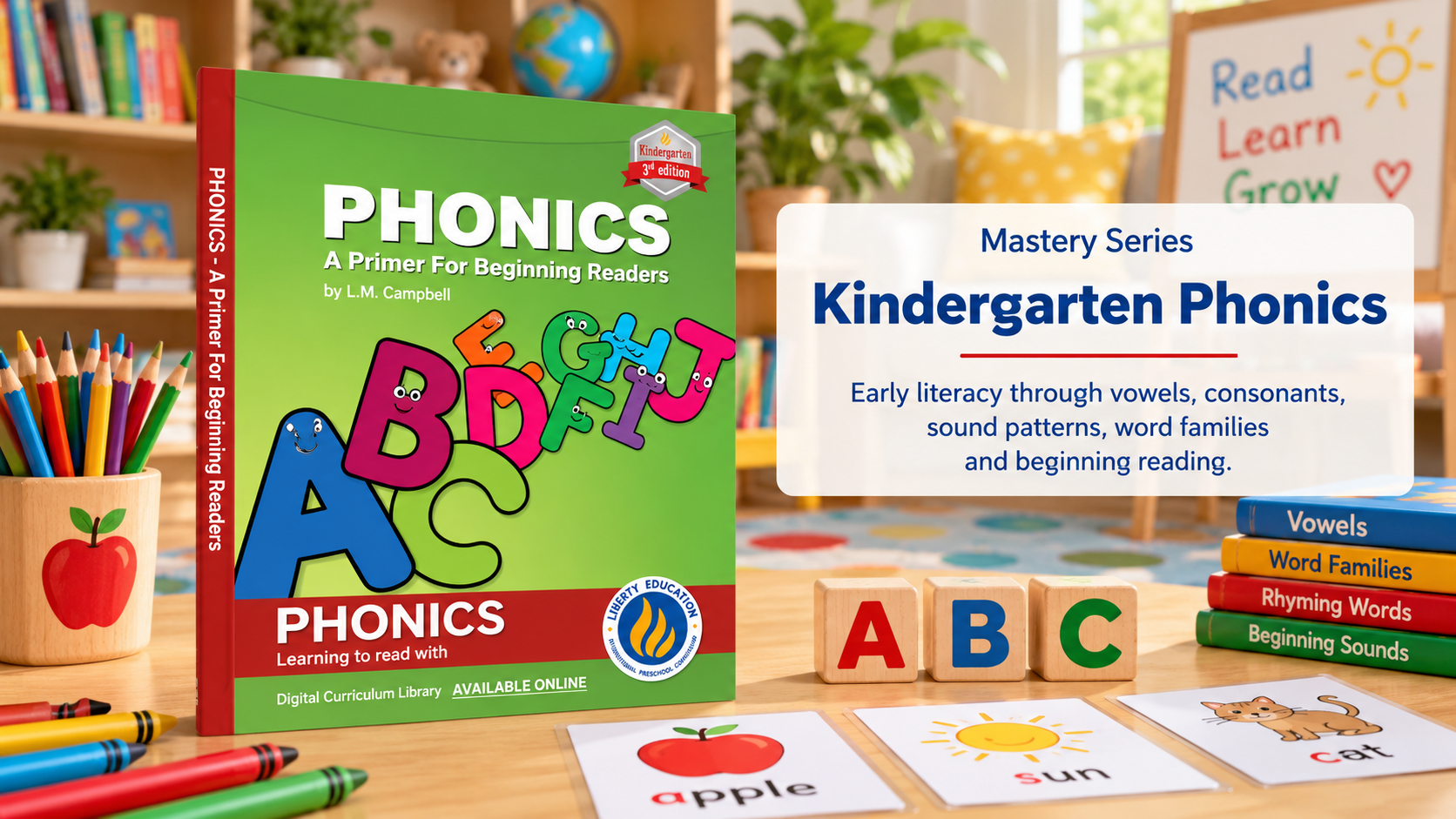
The Mastery Series • Kindergarten • Phonics
Kindergarten Phonics
Advancing early literacy through vowels, consonants, beginning, middle and ending sounds, sound patterns, rhyming, word families, early word reading and writing.
Advancing Toward Early Reading & Writing
Kindergarten Phonics is the third Phonics level in the Mastery Series from Liberty Education. It builds on the alphabet knowledge, letter-sound awareness, vocabulary and writing foundations developed at Nursery and Preschool and extends them into increasingly connected early reading and writing experiences.
Children work with beginning consonant sounds and all five short vowels before examining sounds in different positions within words. They identify beginning, middle and ending sounds, explore rhyming words and sound patterns, read familiar simple words and develop early word-family knowledge.
The program also connects phonics with vocabulary, sentence use, sequencing and story understanding so children increasingly apply their sound knowledge within meaningful language.
A structured Student Book works together with a detailed Teacher Guide to provide stories, songs, movement, vocabulary, games, writing, sound activities and hands-on learning experiences.
Kindergarten Phonics at a Glance
| Series | Mastery Series Early Childhood Curriculum |
|---|---|
| Level | Kindergarten |
| Subject | Phonics |
| Curriculum Focus | Early Literacy |
| Key Sound Work | Beginning consonants, short vowels, middle sounds, ending consonants, rhyming and sound patterns |
| Reading Development | Sound analysis, blending, familiar simple words, rhyming patterns and word families |
| Language Development | Vocabulary, simple sentences, sequencing and early story understanding |
| Curriculum Components | Teacher Guide and Student Book |
| Author | L.M. Campbell and Liberty Education's Curriculum Development Team |
| Edition | Third Edition |
| Publisher | Liberty Education |
What Children Learn
Kindergarten Phonics develops children's ability to hear, recognize and use sounds within words and then apply this knowledge to increasingly connected reading and writing activities.
Beginning Consonant Sounds
Children identify consonants and connect each target letter with its beginning sound. Familiar vocabulary, pictures, stories and oral-language activities help children hear the sound at the beginning of spoken words.
Children also practice uppercase and lowercase letter formation and use target vocabulary in simple sentences.
Short Vowels
Children work explicitly with the five short vowels: a, e, i, o and u.
Vowel instruction connects the written letter with its sound and provides repeated opportunities to hear short vowels in familiar words.
Middle Short-Vowel Sounds
Children learn to listen beyond the beginning of a word and identify short-vowel sounds in the middle position.
Examples of the type of words used in the program include rat, map, bat, pin, bin, fish, hen, red, pen, bed, net and men.
This develops children's ability to analyze more than one part of a spoken word.
Ending Consonant Sounds
Children also learn to listen for sounds at the ends of words. Activities with ending consonants extend sound awareness across the complete word.
Beginning Sound → Middle Sound → Ending Sound
Sound Patterns
Children examine recurring sound patterns in groups of words. These activities help them notice that different words can share the same ending sound pattern.
The Student Book includes focused sound-pattern work and cumulative review so previously introduced patterns can be compared and revisited.
Rhyming Words
Children identify and match words that rhyme, explain how words rhyme and generate additional rhyming words.
Familiar examples include pairs and groups such as cat / hat, pig / dig, man / van, top / hop, bug / rug and pin / tin.
Rhyming activities strengthen children's attention to shared ending sounds and prepare them to recognize recurring patterns across words.
Word Families
Children bring their sound knowledge together through word-family activities. They read and work with groups of words that share a common sound pattern.
The curriculum includes common patterns such as -at, -ig, -an, -op, -ug and -in, with later focused word-family work including -an and -at.
Early Word Reading
Kindergarten Phonics begins connecting individual sounds into complete familiar words.
Children use their knowledge of consonants and short vowels to work with simple words in structured phonics activities. They read words containing taught short-vowel patterns and recognize similarities among related words.
Writing Words
Writing develops alongside sound work. Children practice uppercase and lowercase letters and increasingly use letters within familiar words and phonics activities.
Later word-family work includes completing words, writing familiar words and working with words that share common ending patterns.
Vocabulary & Sentence Development
Target sounds are connected with meaningful vocabulary throughout the program. Children name pictures, discuss familiar words and use vocabulary in simple sentences.
This helps connect phonics with spoken language rather than teaching sounds only as isolated letter exercises.
From Individual Sounds to Words
A major developmental step in Kindergarten Phonics is the movement from identifying isolated letter sounds toward analyzing and reading simple words.
Hear → Identify → Discriminate → Analyze → Connect → Blend → Read → Write
Children first strengthen their recognition of beginning consonants and short vowels. They then listen for sounds in the middle and at the end of words before using recurring sound patterns to support simple word reading.
This helps children understand that spoken and written words are composed of connected sounds that can be recognized and used in predictable ways.
Building Short-Vowel Knowledge
Short vowels are an important part of the Kindergarten Phonics sequence.
Children work with:
- short a;
- short i;
- short o;
- short u; and
- short e.
Children encounter vowels as beginning sounds and as middle sounds within simple words.
Cumulative vowel reviews bring previously learned sounds together, helping children discriminate among different short-vowel sounds and apply that knowledge when working with words.
Sound Patterns, Rhyming & Word Families
As children become more confident with individual sounds, the curriculum draws attention to recurring patterns across words.
Rhyming activities ask children to listen for words that share ending sounds, match rhyming words and think of additional words that rhyme.
Common rhyming patterns used in Teacher Guide activities include:
- -at: cat, hat, mat, rat, sat;
- -ig: pig, dig, big, wig;
- -an: man, van, can, fan;
- -op: top, hop, pop, mop;
- -ug: bug, hug, mug, rug; and
- -in: pin, bin, tin, win.
Later word-family activities provide further opportunities to recognize, read, complete and write words sharing common patterns.
Hear the Pattern → Match → Rhyme → Read → Complete → Write → Generate
Inside the Student Book
The Kindergarten Phonics Student Book moves from individual vowel and consonant work toward increasingly connected sound and word activities.
Children encounter activities such as:
- recognizing and writing uppercase and lowercase letters;
- identifying beginning consonant sounds;
- working with all five short vowels;
- identifying middle short-vowel sounds;
- identifying ending consonant sounds;
- reviewing groups of beginning consonants;
- reviewing groups of short vowels;
- recognizing recurring sound patterns;
- reviewing and comparing sound patterns;
- reading familiar simple words with short vowels;
- matching and generating rhyming words;
- working with beginning and ending sounds;
- exploring word families;
- completing familiar words;
- using vocabulary in simple sentences;
- ordering events;
- identifying what comes before and after; and
- developing early story understanding.
Language, Sequencing & Early Comprehension
Kindergarten Phonics also develops language skills that support children's understanding of words and stories.
Later activities include:
- identifying opposites;
- deciding which items belong together;
- identifying what comes before;
- identifying what comes after;
- putting story events in order;
- using story information to make sense of events; and
- reviewing previously learned language concepts.
These activities extend phonics beyond sound recognition and help children organize and understand language in meaningful contexts.
Teacher-Guided Phonics Learning
The Kindergarten Phonics Teacher Guide expands Student Book instruction through stories, discussion, vocabulary, sound activities, movement, games, writing and hands-on experiences.
Teachers introduce target sounds, model letter formation, guide children in identifying beginning and middle sounds and help children use new vocabulary in simple sentences.
Rhyming lessons may include picture matching, group searches, rhyming games, word lists and opportunities for children to generate their own rhyming words.
Short-vowel review can include word games and picture activities in which children identify the middle vowel sound and read familiar words containing the target vowel.
How Children Learn
Kindergarten Phonics combines explicit sound work with active, multisensory literacy experiences.
Depending on the lesson, children may learn through:
- teacher modeling and guided discussion;
- stories and story questions;
- songs, rhymes and tongue twisters;
- letter and sound identification;
- beginning-, middle- and ending-sound activities;
- short-vowel games;
- picture and vocabulary cards;
- rhyming games;
- sound-pattern activities;
- simple word reading;
- letter and word writing;
- movement and action activities;
- art and craft experiences;
- sensory learning;
- games and manipulatives;
- learning centers; and
- Student Book practice.
Learning Centers & Classroom Exploration
Teacher Guide activities extend phonics into classroom centers where children can revisit sounds, words, vocabulary and writing through different forms of practice.
- Literacy & Language: letters, sounds, vocabulary, rhyming and simple word activities
- Writing: uppercase and lowercase letters, familiar words and rhyming words
- Listening: identifying sounds and rhymes in spoken words, songs and stories
- Games: sound matching, rhyming games and word activities
- Manipulatives: matching and sorting letters, pictures and word cards
- Art: letter crafts, word pictures and phonics-related creative activities
- Movement: action songs, letter games and physical sound activities
- Sensory Exploration: tactile letter and word experiences
- Dramatic Play: using vocabulary and language within imaginative contexts
Phonics & Whole-Child Development
Early literacy is the central curriculum focus, while Kindergarten Phonics also engages broader areas of early childhood development.
Language Development
Phonological awareness, vocabulary, listening, speaking, rhyming, sentence use and early word reading.
Cognitive Development
Auditory discrimination, visual discrimination, sound analysis, matching, sequencing, classification and pattern recognition.
Fine-Motor Development
Letter formation, writing, drawing, cutting, pasting and manipulating literacy materials.
Gross-Motor Development
Action songs, movement games, large-motor letter activities and physical responses to sound and vocabulary.
Social & Emotional Development
Group games, partner activities, communication, turn-taking, cooperation and story-based discussion.
Creative Development
Stories, songs, rhymes, art, movement and imaginative activities provide additional contexts for language and phonics learning.
Kindergarten Phonics Curriculum Sequence
Kindergarten Phonics progresses from individual letter-sound relationships toward increasingly connected analysis and use of sounds within words.
| Learning Area | Development |
|---|---|
| Letter-Sound Knowledge | Connecting uppercase and lowercase letters with their sounds |
| Beginning Consonants | Identifying and using consonant sounds at the beginning of words |
| Short Vowels | Developing explicit knowledge of short a, e, i, o and u |
| Middle Sounds | Identifying short-vowel sounds within simple words |
| Ending Sounds | Listening for and identifying consonant sounds at the ends of words |
| Sound Analysis | Attending to beginning, middle and ending positions within words |
| Sound Patterns | Recognizing and comparing recurring patterns across words |
| Rhyming | Matching, identifying and generating words with shared ending sounds |
| Early Word Reading | Reading familiar simple words containing taught short-vowel patterns |
| Word Families | Reading, completing and writing words with common ending patterns |
| Writing | Writing letters and familiar words within structured phonics activities |
| Vocabulary & Sentences | Developing vocabulary and using familiar words in simple sentences |
| Sequencing & Story Understanding | Ordering events and developing early understanding of story information |
| Cumulative Review | Revisiting consonants, vowels, sound patterns, word relationships and previously learned literacy skills |
Developmental Progression
Kindergarten Phonics represents the integration-and-mastery stage of the Mastery Series Phonics pathway.
Identify → Discriminate → Analyze → Connect → Blend → Read → Write → Sequence → Understand
Children build on the alphabet and beginning-sound foundations established in Nursery and Preschool and increasingly examine how sounds work together within complete words.
See the complete three-level pathway in the Mastery Series Phonics Curriculum Progression .
Completing the Phonics Pathway
Kindergarten Phonics is the third level of the Mastery Series Phonics pathway.
Across Nursery, Preschool and Kindergarten, children progress from early alphabet and sound awareness toward sound analysis, short-vowel knowledge, rhyming, sound patterns and early word reading.
Nursery Foundations → Preschool Development & Application → Kindergarten Integration & Mastery
Scope & Sequence
Explore how Kindergarten Phonics fits within the complete developmental sequence of Mathematics and Phonics learning across Nursery, Preschool and Kindergarten.
Kindergarten Phonics FAQ
What does Kindergarten Phonics teach?
Kindergarten Phonics develops early literacy through beginning consonants, short vowels, middle and ending sounds, sound patterns, rhyming, simple word reading, word families, writing, vocabulary, sentences and early story understanding.
Does Kindergarten Phonics teach all five short vowels?
Yes. Children work explicitly with the short sounds of a, e, i, o and u and encounter these sounds within familiar simple words.
Does Kindergarten Phonics teach beginning, middle and ending sounds?
Yes. Children identify beginning consonant sounds, middle short-vowel sounds and ending consonant sounds, developing awareness of different sound positions within words.
Does Kindergarten Phonics teach children to read words?
Yes. Children begin reading familiar simple words within structured phonics activities, particularly words containing the short-vowel sounds and sound patterns taught in the program.
Does Kindergarten Phonics include rhyming?
Yes. Children identify and match rhyming words, explain shared ending sounds and generate additional words that rhyme.
Does Kindergarten Phonics teach word families?
Yes. Word-family activities help children recognize, read, complete and write groups of words that share common ending patterns. The curriculum includes focused work with families such as -an and -at.
Does Kindergarten Phonics include blending?
The program brings consonant and short-vowel knowledge together so children can connect sounds smoothly when working with simple words and recurring sound patterns.
Does Kindergarten Phonics include writing?
Yes. Children continue to practice uppercase and lowercase letter formation and increasingly write familiar words within phonics and word-family activities.
Does the program include comprehension activities?
Yes. Later activities include story order, story sense, before-and-after relationships, grouping and other language tasks that develop early understanding and sequencing.
Is Kindergarten Phonics only a workbook?
No. The Student Book is supported by a Teacher Guide that expands phonics instruction through stories, songs, vocabulary, movement, rhyming games, sound activities, writing, art, sensory experiences, manipulatives and classroom learning centers.
How does Kindergarten Phonics connect with Nursery and Preschool?
Nursery Phonics establishes early alphabet, sound and vocabulary foundations. Preschool Phonics strengthens letter-sound discrimination, beginning sounds, writing and cumulative alphabet knowledge. Kindergarten Phonics builds on those foundations through short vowels, sound positions, rhyming, sound patterns and early word reading.