



Preschool Curriculum for Homeschooling Parents: A Practical Guide to Learning at Home
Homeschooling a young child can be one of the most rewarding ways to support their early development. It gives families the freedom to follow a child's interests, spend more time on challenging concepts, and turn everyday experiences into meaningful learning opportunities.
But homeschooling also brings an important question: How do you know what to teach, in what order, and which activities will help your child learn?
A structured preschool homeschooling curriculum can make a significant difference. It provides a clear learning pathway while allowing parents to adapt lessons to their child's pace, interests, and developmental readiness.
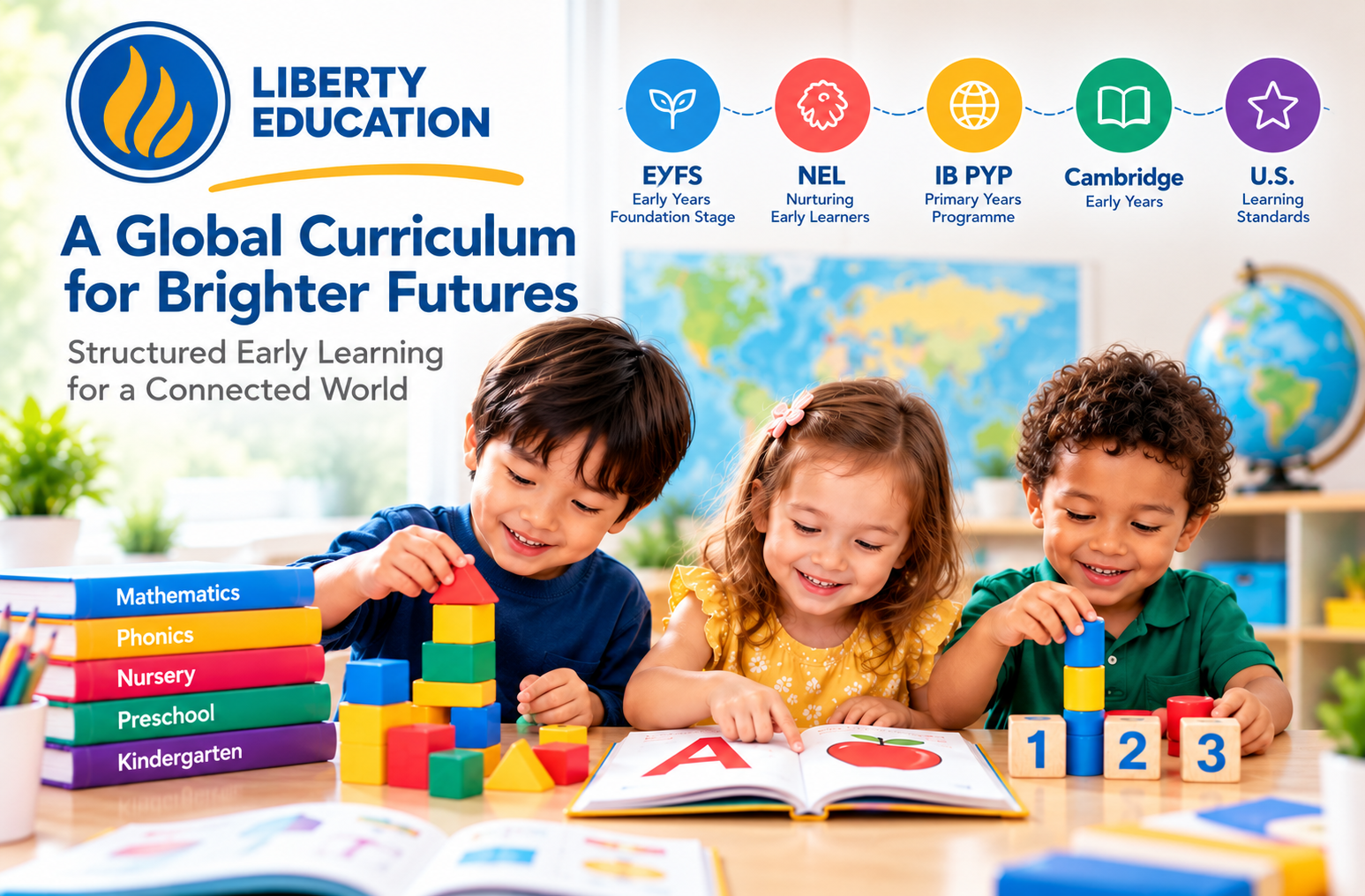
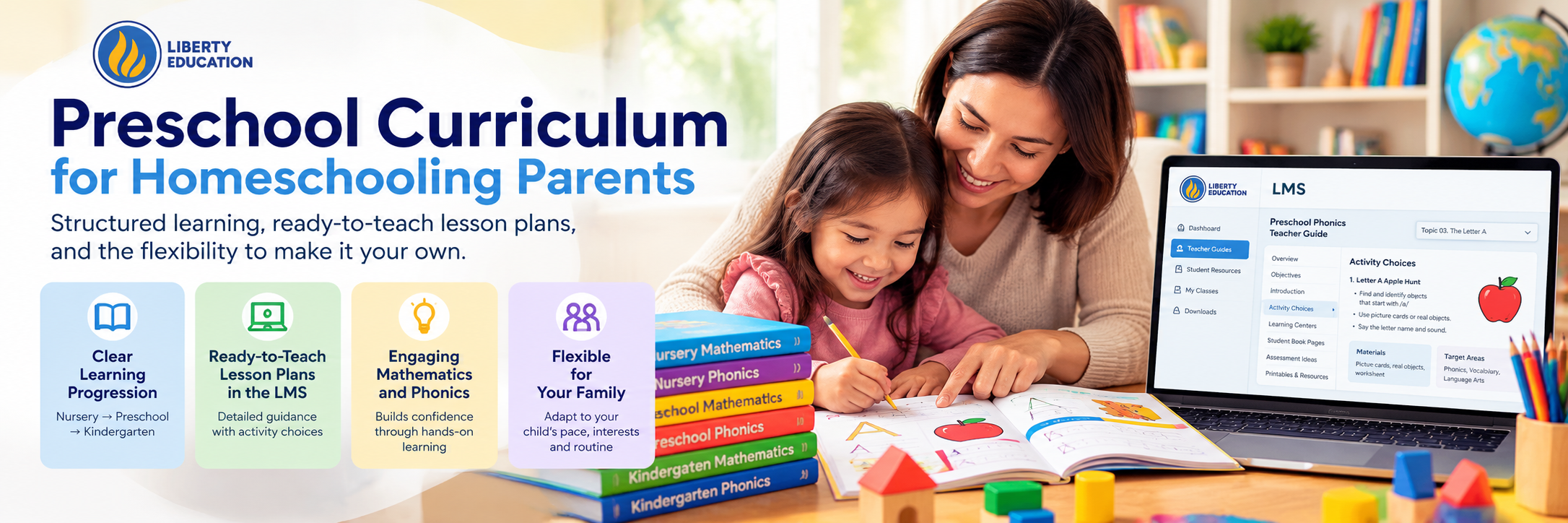
Liberty Education's Mastery Series combines Mathematics and Phonics Student Books for Nursery, Preschool, and Kindergarten with detailed online Teacher Guides. The Student Books establish the sequence of learning, while the Teacher Guides, accessed through the Liberty Learning Management System (LMS), provide ready-to-teach lesson plans with clear objectives and a choice of activities.
This approach allows parents to spend less time figuring out how to plan lessons and more time enjoying the learning process with their children.
1. Start with a Clear Learning Progression
One of the challenges of preschool homeschooling is deciding which concepts to introduce first and how to build upon them.
The Mastery Series follows a three-level developmental progression:
Nursery — Foundation
Children explore early Mathematics and Phonics through recognition, matching, counting, colors, shapes, alphabet awareness, letter sounds, vocabulary, and hands-on experiences.
Preschool — Development & Application
Children strengthen their understanding through number representation, counting, sorting, sequencing, letter-sound associations, beginning-sound awareness, alphabet sequencing, and letter formation.
Kindergarten — Integration & Mastery
Children extend their learning into more advanced number concepts, mathematical reasoning, measurement, introductory addition, and early reading and writing through phonics blending, short vowels, word families, and simple words.
The progression is designed to connect learning across all three levels, rather than treating each book as a separate collection of activities.
For homeschooling parents, this makes it easier to understand where a child is in the learning sequence and what comes next.
Explore the Mastery Series Curriculum
2. Use the Online Teacher Guides to Plan Your Lessons
A Student Book tells you what children are learning. A Teacher Guide should help you understand how to teach it.
This is a central feature of the Liberty Education curriculum.
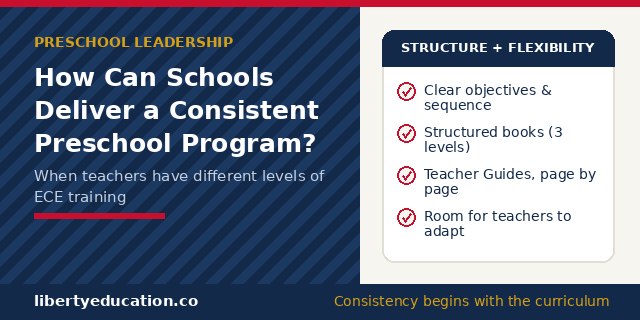
The Teacher Guides are housed in the Liberty LMS and contain detailed, ready-to-teach lesson plans that follow the Student Books page by page.
Each lesson provides clearly defined learning objectives and suggested teaching experiences designed to address those objectives.
Depending on the lesson, parents can find:
-
Suggested introductions, stories, songs, and rhymes.
-
Guided questions and vocabulary activities.
-
Hands-on Mathematics or Phonics activities.
-
Movement, creative, and fine-motor experiences.
-
Suggested materials and preparation.
-
Learning-center ideas for additional practice.
-
Opportunities to observe children's understanding and progress.
Importantly, the Teacher Guides provide activity choices.
A parent does not necessarily need to complete every suggested activity. Instead, they can select those most appropriate for their child's interests, readiness, attention span, and available materials.
For example, a Mathematics lesson about oval shapes might offer a classroom-style shape hunt, an art activity, tracing practice, a song, and a movement game. At home, a parent could choose two or three activities that suit the child while still addressing the lesson's learning objectives.
The lesson planning is already provided. The parent decides how best to deliver the learning experience.
Access the Liberty LMS: https://lms.libertyeducation.co/
3. Create a Flexible Homeschooling Schedule
Homeschooling does not have to reproduce a traditional school timetable.
Young children benefit from routines, but they also need time for play, movement, conversation, rest, and exploration.
A simple homeschooling morning might include a short Phonics lesson, a break for outdoor play, a Mathematics activity, and a story or creative project.
Other families may prefer shorter learning sessions spread throughout the day.
The Mastery Series supports this flexibility because the curriculum sequence is already established. Parents can decide when to introduce a lesson, how much time to spend on it, and whether their child would benefit from additional practice before moving forward.
The goal is consistent, meaningful learning—not completing a fixed number of pages every day.
4. Make Mathematics Part of Everyday Life
Early mathematics becomes more meaningful when children connect numbers, shapes, quantities, and comparisons with familiar experiences.
Parents can reinforce Mathematics concepts through simple household activities.
Counting fruit while preparing a snack supports number awareness and one-to-one correspondence. Sorting laundry by color or size reinforces classification. Comparing containers introduces mathematical language such as bigger, smaller, more, and less.
Looking for circles, rectangles, and triangles around the home helps children recognize shapes beyond the Student Book.
Older children working at the Kindergarten level can explore number order, patterns, introductory measurement, and simple addition using familiar objects.
These experiences complement the structured Mathematics lessons and help children apply what they are learning.
The curriculum provides the concepts and sequence; everyday life provides additional opportunities to practice them.
5. Build Phonics Skills Through Stories, Sounds, and Conversation
Early Phonics instruction is about more than memorizing the alphabet.
Children need repeated opportunities to hear sounds, recognize letters, develop vocabulary, and connect spoken language with written symbols.
In Nursery Phonics, children explore uppercase and lowercase letters, target sounds, familiar beginning-sound vocabulary, oral language, and emerging letter formation.
Preschool Phonics builds on these foundations through handwriting readiness, letter-sound relationships, beginning-sound discrimination, alphabet sequencing, and cumulative review.
Kindergarten Phonics extends learning into beginning and ending consonants, middle short vowels, blending, rhyming patterns, word families, simple word reading and writing, and early comprehension.
At home, parents can reinforce these skills through picture books, alphabet games, sound hunts, rhymes, storytelling, letter tracing, and conversations about familiar objects.
For example, when introducing a letter, a parent might begin with a story, identify objects beginning with the target sound, practice the letter shape, and finish with a Student Book activity.
The online Teacher Guide provides lesson-specific ideas, helping parents connect these activities to the intended learning objectives.
6. Adapt Activities to Your Child's Readiness
Every child develops differently.
One child may enjoy tracing and writing, while another may need more opportunities to build fine-motor control before working comfortably with a pencil.
Some children recognize letters quickly but require more practice distinguishing their sounds. Others understand counting through physical objects before they can confidently recognize written numerals.
Homeschooling provides the opportunity to respond to these differences.
The Teacher Guides support this approach by offering a selection of activities that address the same lesson objectives in different ways.
Parents can choose more concrete, movement-based, visual, or creative activities when appropriate. They can also revisit earlier lessons or provide additional practice.
For children who need more support or additional challenge, the activities can be adjusted to suit their readiness. However, families seeking specialized instruction or accommodations should consider professional guidance where appropriate; a general curriculum does not replace individualized educational support.
The learning objective provides direction, while the activity choices allow flexibility.
7. Include Hands-On Learning and Creative Exploration
Preschool children learn through doing.
Hands-on activities allow children to connect new ideas with real objects, movement, observation, and conversation.
The Liberty Teacher Guides incorporate a variety of practical learning experiences, including sorting, matching, art, construction, stories, songs, movement games, sensory activities, and selected STEAM investigations.
These experiences support more than academic learning.
Tracing and manipulating materials help develop fine-motor coordination. Stories and discussions encourage vocabulary and oral language. Sorting and classification activities develop observation and reasoning. Group or family games provide opportunities for cooperation and turn-taking.
Parents can also introduce additional enrichment activities such as nature walks, simple cooking experiences, gardening, or age-appropriate science exploration.
These activities can complement the Mathematics and Phonics curriculum without needing to be presented as separate subjects formally covered by the six Student Books.
8. Use the LMS as Your Homeschooling Teaching Resource
One advantage of the Liberty Education approach is that the instructional guidance is available digitally.
Rather than relying on a separate printed Teacher Guide, parents can access the lesson plans through the Liberty Learning Management System.
This creates a practical division between the two main curriculum resources:
Student Books: The physical learning materials children use to explore, practice, and record their understanding.
Online Teacher Guides: The lesson plans parents use to understand objectives, prepare activities, guide instruction, and reinforce learning.
Before a lesson, a parent can review the relevant Teacher Guide, select suitable activities, and prepare any materials required.
During the lesson, the parent can combine the Student Book with the suggested hands-on experiences.
Afterward, the parent can observe how the child responded and decide whether to continue, revisit, or reinforce the concept.
This approach provides structure without requiring parents to create an entire teaching program independently.
Explore the Liberty Education LMS
9. Observe Progress Without Turning Every Lesson into a Test
Young children's learning is often most visible during everyday activities.
A child who correctly matches a numeral to a group of objects is demonstrating number understanding. A child who recognizes a letter and identifies a familiar word beginning with its sound is showing developing Phonics knowledge.
Parents can observe these skills through conversation, play, guided activities, and Student Book practice.
The Teacher Guides provide learning objectives that help parents identify what each lesson is intended to develop.
Rather than focusing only on whether a page has been completed, parents can consider questions such as:
-
Can my child recognize or explain the concept?
-
Can they demonstrate the skill using real objects or pictures?
-
Do they still need teacher or parent support?
-
Would another activity help reinforce the learning?
-
Are they ready to extend the concept?
These observations help parents make informed decisions about pacing and repetition.
10. Make Time for Social Interaction and Broader Experiences
Homeschooling offers opportunities for individual attention, but young children also benefit from interaction with other children and adults.
Families may choose to participate in local homeschooling groups, community activities, library events, sports, music, art classes, or age-appropriate educational outings.
These experiences can help children practice communication, cooperation, independence, and social confidence.
They also create opportunities to apply learning beyond the home.
A visit to a market can become a counting and classification activity. A trip to the park can encourage shape recognition, comparison, observation, and vocabulary. Shared story time can support listening and oral language.
A structured Mathematics and Phonics curriculum can therefore form part of a broader early childhood learning experience that includes play, relationships, creativity, and community participation.
A Structured Curriculum That Leaves Room for Family Life
Effective preschool homeschooling does not require parents to recreate a conventional classroom.
It requires a clear understanding of what children are learning, appropriate activities that support those objectives, and the flexibility to respond to each child's development.
Liberty Education's Mastery Series provides this combination through six coordinated Mathematics and Phonics Student Books and detailed online Teacher Guides.
The Student Books establish the learning progression from Nursery through Preschool to Kindergarten. The Teacher Guides provide coherent, ready-to-teach lesson plans with clearly defined objectives and activity choices.
Parents can follow the sequence, select suitable activities, and adapt the learning experience to their child's needs.
The curriculum provides the structure. The Teacher Guides provide the lesson plans. Parents bring the learning to life.
Explore Liberty Education for Homeschooling
Families considering Liberty Education can explore the curriculum content, review how learning progresses across the three levels, and discover how the online Teacher Guides support practical lesson delivery.
View the Complete Scope & Sequence
Explore Mathematics Progression
Access the Liberty LMS
Liberty Education — Structured Learning. Flexible Teaching. Strong Foundations.


