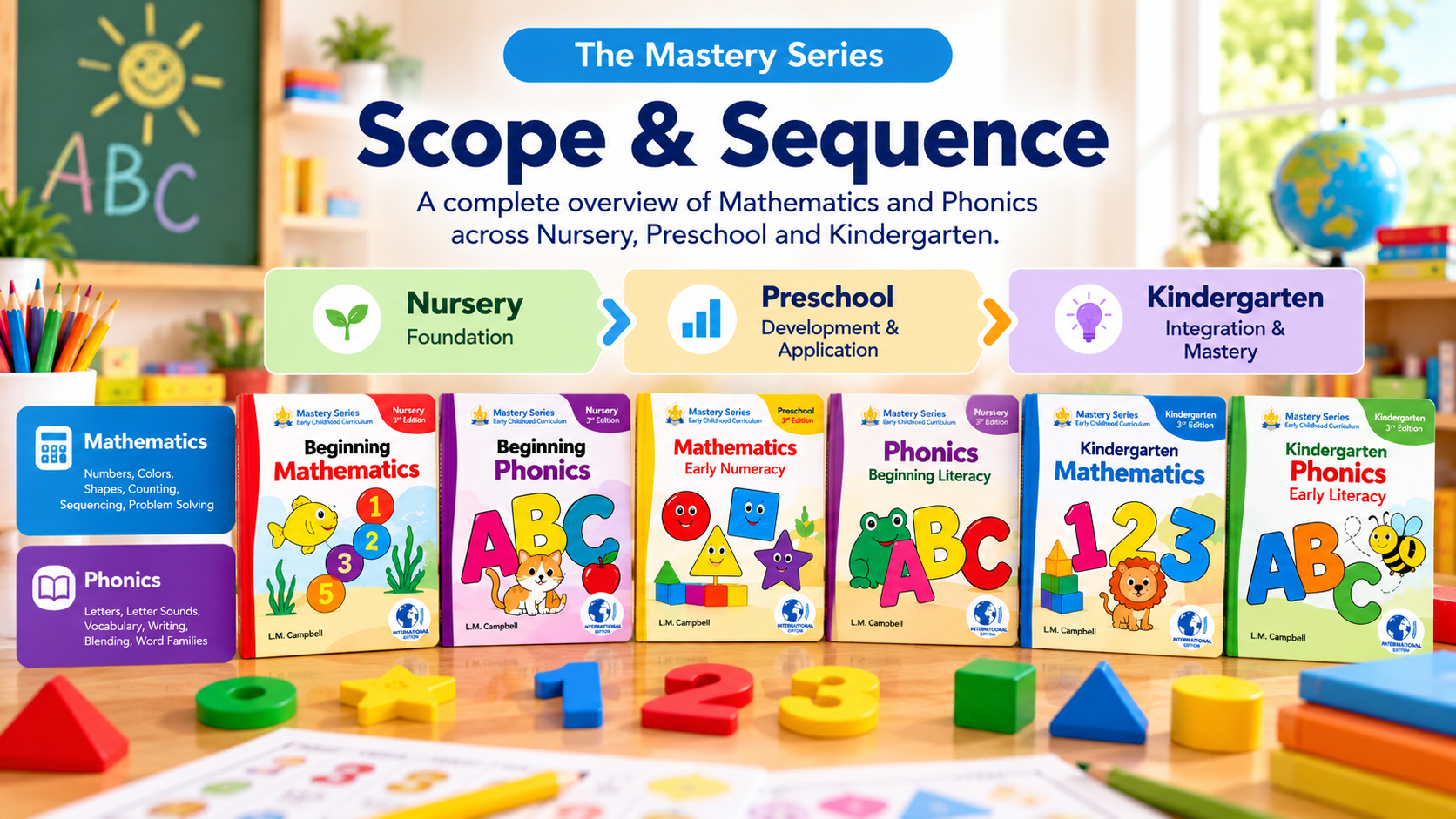
The Mastery Series • Curriculum Overview
Mastery Series Scope & Sequence
A developmental overview of Mathematics and Phonics learning across Nursery, Preschool and Kindergarten.
The Mastery Series from Liberty Education provides a connected early childhood curriculum across three developmental levels and two core subject areas: Mathematics and Phonics.
This Scope & Sequence shows how learning develops from foundational exploration and recognition in Nursery, through development and application in Preschool, to increasingly connected mathematical reasoning, early reading and writing in Kindergarten.
Curriculum at a Glance
Each level of the Mastery Series builds on earlier learning while introducing new concepts appropriate to the next stage of development.
| Level | Mathematics | Phonics |
|---|---|---|
| Nursery Foundation |
Nursery Mathematics Numbers 1–10, counting, quantities, number words, colors, shapes, matching and sequencing. |
Nursery Phonics Alphabet awareness, uppercase and lowercase letters, letter names, target sounds, beginning-sound vocabulary, oral language and emerging letter formation. |
| Preschool Development & Application |
Preschool Mathematics Numbers 0–10, quantities, number words, numeral representation, sequencing, colors, geometry, sorting, classification, spatial concepts and integrated review. |
Preschool Phonics Pre-writing skills, alphabet knowledge, letter-sound relationships, beginning-sound discrimination, vocabulary, uppercase and lowercase matching, letter formation, alphabet sequence and cumulative review. |
| Kindergarten Integration & Mastery |
Kindergarten Mathematics Numbers 0–20, number order, comparison, patterns, geometry, measurement, ordinal numbers, telling time, money, early addition, spatial awareness and mathematical reasoning. |
Kindergarten Phonics Beginning consonants, short vowels, middle and ending sounds, sound patterns, rhyming, blending, familiar simple word reading, word families, writing, sequencing and early comprehension. |
A Connected Developmental Sequence
The Mastery Series is organized as a developmental pathway rather than six unrelated books. Mathematics and Phonics both become progressively more complex as children move through the three levels.
Nursery — Foundation
Nursery emphasizes first experiences with concepts. Children explore, recognize, name, match and respond through concrete, visual, language-rich and multisensory activities.
Experience → Explore → Recognize → Name → Match → Respond
Preschool — Development & Application
Preschool strengthens recognition while asking children to discriminate, classify, sequence, represent and apply what they know in increasingly structured activities.
Recognize → Identify → Discriminate → Match → Classify → Sequence → Represent → Apply
Kindergarten — Integration & Mastery
Kindergarten connects earlier knowledge with more advanced mathematical and literacy tasks. Children compare, analyze, represent, read, write, reason and apply their learning in increasingly connected ways.
Analyze → Compare → Connect → Read → Write → Reason → Apply
FOUNDATION → DEVELOPMENT → APPLICATION → INTEGRATION
Mathematics Scope & Sequence
Mathematics develops from concrete experiences with numbers, quantities, colors and shapes toward number relationships, measurement, early addition and mathematical reasoning.
Experience → Recognize → Count → Match → Represent → Sequence → Compare → Measure → Add → Apply → Reason
| Learning Area | Nursery Mathematics | Preschool Mathematics | Kindergarten Mathematics |
|---|---|---|---|
| Number Development | Numbers 1–10; numeral recognition and number names | Numbers 0–10; recognition and increasingly connected number representations | Numbers 0–20 as the core number sequence, with extended counting practice to 100 |
| Counting & Quantity | Count objects and connect numerals with quantities | Count, quantify and match numbers with groups of objects | Count sets and objects and use quantity knowledge in comparison and early addition |
| Numeral Formation | Trace and begin writing numerals | Trace, write and represent numbers | Write numbers and use written numerals in increasingly varied mathematical activities |
| Number Words | Connect familiar numerals with number words | Read, trace and connect number words with numerals and quantities | Connect spoken number names, written numerals, number words and quantities |
| Sequence & Number Order | Sequence numbers 1–10 and work with early number-line activities | Sequence numbers and arrange numbered objects or puzzle pieces in order | Identify missing numbers, complete sequences and order numbers |
| Colors | Recognize, name, match and explore familiar colors | Recognize, name, match and apply color knowledge, including cumulative color review | Reinforce color recognition through integrated number, pattern and classification activities |
| Shapes & Geometry | Recognize and name familiar shapes | Identify, match and classify shapes; explore characteristics such as number of sides | Recognize, identify, draw, match and classify familiar shapes |
| Matching & Classification | Match numbers, quantities, colors and shapes | Sort, match and classify objects, colors, shapes and mathematical representations | Use classification and matching within increasingly complex visual and mathematical tasks |
| Spatial Concepts | — | Develop orientation and positional understanding, including left-to-right experiences and spatial concepts | Work with left and right, top and bottom, orientation and spatial relationships |
| Comparison | — | — | Compare sets, quantities, numbers, size, height and length |
| Patterns | — | — | Observe, recognize and continue patterns |
| Measurement | — | — | Compare length and height, measure in centimeters and use a ruler |
| Ordinal Numbers | — | — | Understand ordered position from first through fifth |
| Time & Calendar | — | — | Tell time to the hour and work with days, dates, days of the week and months of the year |
| Money | — | — | Explore coins and simple coin relationships |
| Early Addition | — | — | Combine quantities using counters, pictures and simple addition problems |
| Mathematical Reasoning | Matching, sequencing and early classification | Sorting, classification, integrated number-and-shape activities and problem-solving experiences | Visual perception, logical thinking, comparison, classification, noticing details and problem solving |
Explore Mathematics by Level
Nursery Mathematics → | Preschool Mathematics → | Kindergarten Mathematics →
For a more detailed explanation of how mathematical learning develops across all three levels, visit the Mathematics Curriculum Progression .
Phonics Scope & Sequence
Phonics develops from early alphabet awareness and letter-sound experiences toward sound discrimination, analysis of sounds within words, rhyming, sound patterns, word families and early word reading.
Hear → Recognize → Connect → Discriminate → Analyze → Blend → Read → Write → Understand
| Learning Area | Nursery Phonics | Preschool Phonics | Kindergarten Phonics |
|---|---|---|---|
| Alphabet Knowledge | Recognize and name uppercase and lowercase letters | Strengthen recognition, naming and alphabet knowledge | Apply established letter knowledge within increasingly connected phonics activities |
| Letter-Sound Relationships | Hear and say the target sound associated with each letter | Strengthen connections between letters and their sounds | Apply letter-sound knowledge to consonants, short vowels and simple words |
| Uppercase & Lowercase Matching | Match capital and small forms of target letters | Match and identify uppercase and lowercase forms | Use uppercase and lowercase knowledge within reading and writing activities |
| Beginning Sounds | Connect familiar vocabulary with target beginning sounds | Identify and discriminate words by beginning sound | Develop and review beginning consonant sounds across a wider range of words |
| Short Vowels | — | — | Explicit work with short a, e, i, o and u |
| Middle Sounds | — | — | Identify short-vowel sounds in the middle of familiar simple words |
| Ending Sounds | — | — | Listen for and identify consonant sounds at the ends of words |
| Sound Analysis | Focus attention on target letter sounds | Discriminate target beginning sounds | Attend to beginning, middle and ending positions within words |
| Blending | — | — | Connect taught consonant and short-vowel sounds smoothly within simple word activities |
| Rhyming | Experience rhyme through songs, stories and oral language | Continue rhyme-rich language experiences through songs and classroom activities | Identify, match and generate rhyming words |
| Sound Patterns | — | — | Recognize and compare recurring ending patterns across familiar words |
| Early Word Reading | — | — | Read familiar simple words containing taught short-vowel sounds and patterns |
| Word Families | — | — | Read, complete and write familiar words sharing common ending patterns, including focused work with -an and -at |
| Pre-Writing Skills | Fine-motor and emerging writing experiences | Pencil grip and structured vertical, horizontal, slanting, zigzag, curved and circular line practice | Apply established fine-motor control to letter and word writing |
| Letter Formation | Begin tracing and forming familiar letters | Practice writing uppercase and lowercase letters | Continue letter formation while increasingly writing within word activities |
| Vocabulary | Build vocabulary associated with each target letter | Expand beginning-sound vocabulary and discuss word meanings | Use target vocabulary within phonics, word and sentence activities |
| Oral Language & Sentences | Discuss vocabulary and create simple phrases and sentences | Use target vocabulary in simple phrases and sentences | Connect phonics vocabulary with simple sentence use and story discussion |
| Alphabet Sequence & Review | Sequence letters and revisit previously introduced letters | Use cumulative alphabet reviews from smaller groups toward A–Z | Review consonants, vowels and previously learned sound relationships |
| Sequencing & Early Comprehension | — | — | Work with opposites, grouping, before and after, story order and early story understanding |
Explore Phonics by Level
Nursery Phonics → | Preschool Phonics → | Kindergarten Phonics →
For a more detailed explanation of how early literacy develops across the three levels, visit the Phonics Curriculum Progression .
Learning Beyond Mathematics & Phonics
Although Mathematics and Phonics provide the central academic structure of the Mastery Series, Teacher Guide activities connect learning with multiple areas of early childhood development.
| Developmental Area | Examples Across the Series |
|---|---|
| Cognitive Development | Recognition, matching, sorting, classification, sequencing, visual discrimination, logical thinking and problem solving |
| Language Development | Vocabulary, listening, speaking, mathematical language, letter sounds, sentences, stories and discussion |
| Fine-Motor Development | Tracing, writing, drawing, coloring, cutting, pasting and manipulating classroom materials |
| Gross-Motor Development | Movement games, number activities, action songs, large-motor letter activities and classroom exploration |
| Social & Emotional Development | Partner activities, group games, cooperation, communication, turn-taking and shared problem solving |
| Creative Arts | Drawing, painting, collage, crafts, music, movement and imaginative activities |
| STEAM | Counting, geometry, measurement, construction, observation, classification and hands-on investigation |
| Sensory Learning | Tactile letter and number experiences, art materials, manipulatives and hands-on exploration |
How Children Learn Across the Series
Teacher Guides extend Student Book learning through active classroom experiences. Depending on the concept and developmental level, children may learn through:
- teacher modeling and guided discussion;
- stories, rhymes and songs;
- movement and action activities;
- real objects and manipulatives;
- matching, sorting and classification;
- number and letter games;
- vocabulary and oral-language activities;
- art and craft experiences;
- fine- and gross-motor activities;
- sensory exploration;
- STEAM connections;
- learning centers;
- guided practice; and
- Student Book application.
This allows children to encounter important concepts in multiple ways before applying their learning in increasingly structured activities.
Explore the Six Mastery Series Programs
Each program has a dedicated curriculum page with a more detailed explanation of what children learn and how the Teacher Guide and Student Book support instruction.
Nursery Mathematics
Building Early Mathematical Foundations
Numbers 1–10, counting, quantities, number words, colors, shapes, matching and sequencing.
Nursery Phonics
Building Letter & Sound Foundations
Alphabet awareness, letter recognition, target sounds, vocabulary, beginning sounds, case matching and emerging letter formation.
Preschool Mathematics
Developing Mathematical Understanding & Application
Numbers 0–10, quantities, number words, sequencing, colors, geometry, sorting, classification, spatial concepts and integrated review.
Preschool Phonics
Strengthening Sound Discrimination & Letter Application
Pre-writing, alphabet knowledge, letter sounds, beginning-sound discrimination, vocabulary, letter formation, sequencing and cumulative review.
Kindergarten Mathematics
Extending Mathematical Thinking & Reasoning
Numbers 0–20, number order, comparison, patterns, geometry, measurement, ordinal numbers, time, money, early addition and mathematical reasoning.
Kindergarten Phonics
Advancing Toward Early Reading & Writing
Beginning consonants, short vowels, middle and ending sounds, sound patterns, rhyming, word families, early word reading, writing and early comprehension.
Explore the Mastery Series Curriculum
Use the following curriculum resources to explore the Mastery Series from different perspectives.
Mathematics Curriculum Progression
Follow mathematical development from early number and quantity experiences through comparison, measurement, early addition and mathematical reasoning.
Explore the Mathematics Curriculum Progression →
Phonics Curriculum Progression
Follow literacy development from alphabet and sound awareness through sound discrimination, short vowels, sound analysis, rhyming, word families and early word reading.
Explore the Phonics Curriculum Progression →
Mastery Series Frequently Asked Questions
Find answers about curriculum levels, subjects, Teacher Guides, Student Books, developmental progression and classroom use.
Mastery Series Overview
Return to the main Mastery Series page for an overview of the complete Nursery, Preschool and Kindergarten curriculum.