A Smarter Approach to Early Childhood Education: Liberty Education's Mastery Series Curriculum
Structured Learning, Ready-to-Teach Lesson Plans, and Flexible Implementation
Delivering a high-quality preschool curriculum requires more than attractive textbooks or a collection of classroom activities. Schools and homeschooling families need a clear learning progression, well-defined educational objectives, and practical guidance that helps educators turn curriculum content into meaningful learning experiences.
Liberty Education's Mastery Series brings these essential elements together through a structured early childhood Mathematics and Phonics curriculum for Nursery, Preschool, and Kindergarten.
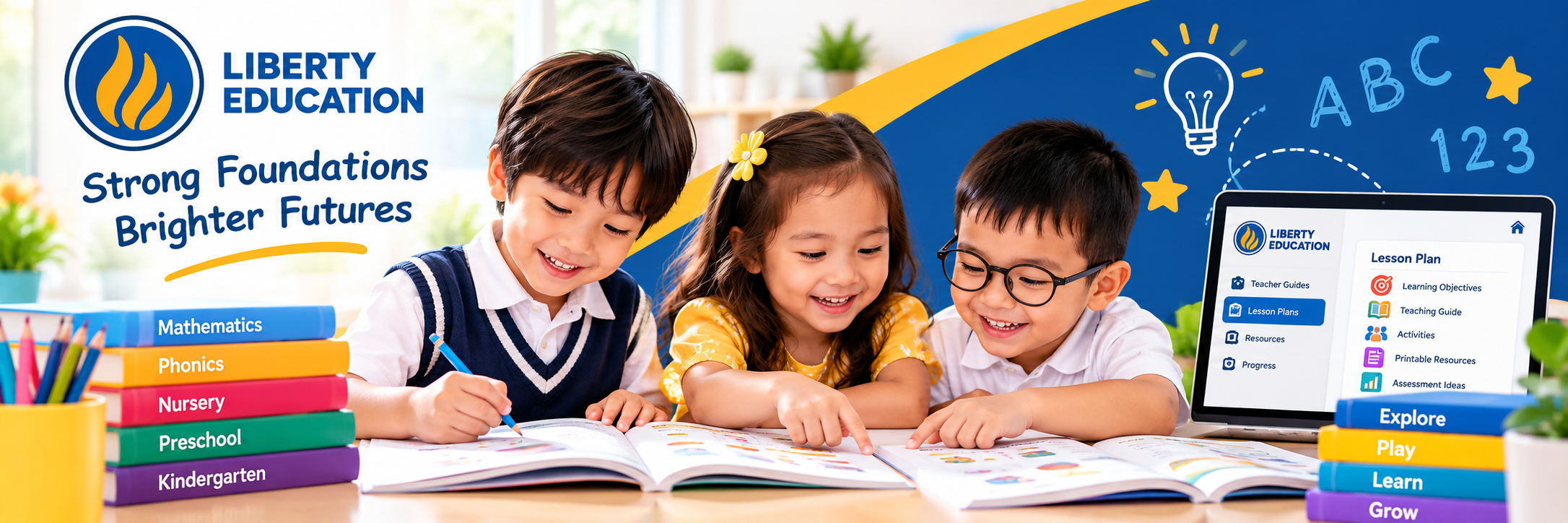
The program combines six coordinated Student Books with detailed online Teacher Guides, available through the Liberty Learning Management System (LMS). Each Teacher Guide provides coherent, ready-to-teach lesson plans connected to the Student Book pages, with clear learning objectives and a selection of activities teachers and parents can choose from.
Developed with the practical realities of international education in mind, the Mastery Series supports consistent instruction while allowing schools and families to adapt learning experiences to their own circumstances.
A Connected Curriculum from Nursery to Kindergarten
One of the challenges facing early childhood educators is maintaining continuity as children progress from introductory learning experiences toward more advanced academic skills.
Without a clear curriculum sequence, important concepts may be repeated unnecessarily, introduced too early, or overlooked.
The Mastery Series addresses this through a documented three-level learning progression.
Nursery — Foundation
Nursery Mathematics introduces early number awareness, counting, colors, shapes, matching, and classification.
Nursery Phonics develops alphabet recognition, letter-sound awareness, beginning-sound vocabulary, oral language, and emerging letter formation.
Children encounter foundational concepts through stories, songs, movement, exploration, and hands-on learning.
Preschool — Development & Application
Preschool Mathematics extends number recognition, quantities, number representation, sorting, sequencing, shapes, colors, and spatial understanding.
Preschool Phonics strengthens alphabet knowledge, beginning-sound awareness, handwriting readiness, letter formation, and cumulative recognition of letters and sounds.
Children gain additional opportunities to practice, represent, and apply concepts introduced during Nursery.
Kindergarten — Integration & Mastery
Kindergarten Mathematics develops number understanding through 20, with extended counting experiences to 100, alongside comparison, patterns, geometry, measurement, time, money, ordinal numbers, and introductory addition.
Kindergarten Phonics extends learning into beginning and ending consonants, medial short vowels, blending, rhyming patterns, word families, simple word reading and writing, and early comprehension.
Across all three levels, the curriculum moves from foundational recognition and exploration toward increasingly connected mathematical and literacy skills.
This progression helps educators understand not only what children are learning, but how that learning develops from one level to the next.
Explore the Mastery Series Curriculum
Teacher Guides That Make the Curriculum Practical to Deliver
A well-structured curriculum is only valuable when educators can implement it effectively.
This is why Liberty Education places particular emphasis on its Teacher Guides.
Rather than leaving teachers to develop their own lesson plans from broad curriculum objectives, the Liberty LMS provides detailed, ready-to-teach lesson plans that follow the Student Books page by page.
The lesson plans include clear learning objectives, teaching guidance, suggested introductions, stories, songs, discussions, hands-on activities, materials, and opportunities to observe children's progress.
Importantly, the Teacher Guides provide a choice of activities designed to address the lesson objectives.
Teachers are not expected to deliver every suggested activity. They can select, combine, or adapt activities according to student readiness, language needs, classroom resources, available teaching time, and their preferred instructional approach.
For example, a lesson introducing a geometric shape may include a story, a movement game, a classroom shape hunt, an art activity, and guided Student Book practice.
Each activity offers a different way to explore or reinforce the intended concept.
The academic objectives remain consistent, while the teacher retains professional judgment over classroom delivery.
The Student Books provide the learning sequence. The online Teacher Guides provide the lesson plans. Educators bring those lessons to life.
Supporting Schools with Different Resources and Teaching Environments
Early childhood education takes place in a wide variety of settings.
A well-resourced international school may have specialist teachers, extensive classroom materials, and dedicated learning spaces. A smaller preschool or rural school may operate with fewer resources and teachers who have different levels of formal early childhood training.
Both environments benefit from a clearly structured curriculum and accessible instructional guidance.
Liberty Education's approach is designed to reduce the amount of lesson development required from individual teachers.
By providing common learning objectives, coordinated Student Books, and ready-to-teach lesson plans through the LMS, the curriculum offers a practical instructional foundation that can be used across different classrooms and school settings.
Teachers can select activities that suit the materials available to them, while school leaders can refer to the same curriculum progression and learning objectives.
Digital access does not, by itself, eliminate differences in educational resources or teacher preparation. However, it can make organized curriculum guidance more accessible wherever suitable devices, connectivity, and LMS access are available.
For schools seeking to improve consistency, this combination of structured content and adaptable teaching guidance offers a practical starting point.
Why the Liberty LMS Matters
The Liberty Learning Management System is an important part of the curriculum's delivery model.
The LMS houses the Teacher Guides and their detailed lesson plans. These are not simply digital copies of the Student Books or collections of unrelated teaching ideas.
They provide the instructional guidance that connects each Student Book lesson with its intended learning objectives and suggested classroom activities.
Teachers can use the LMS to prepare lessons, review teaching options, and identify appropriate materials before working with children.
For school groups, online access can also support a shared approach to curriculum implementation across classrooms and locations.
For homeschooling parents, the LMS provides practical teaching guidance without requiring them to create lesson plans independently.
The digital Teacher Guides complement the physical Student Books, bringing together structured learning materials and flexible lesson delivery.
The Role of AI in Early Childhood Curriculum Planning
Artificial intelligence offers new opportunities to support teachers and homeschooling parents, particularly when adapting existing learning experiences or developing supplementary resources.
AI tools can assist educators in brainstorming activity variations, simplifying explanations, preparing vocabulary practice, or suggesting ways to use familiar household and classroom materials.
However, AI-generated content should not replace a coherent, documented curriculum or the professional judgment of an educator.
Liberty Education's Mastery Series establishes its Mathematics and Phonics progression through the Student Books and Teacher Guides. The core lesson plans are already provided in the LMS.
AI can be used as an additional planning aid where appropriate, helping educators explore alternative approaches while keeping the curriculum's learning objectives in view.
For example, a teacher working with multilingual learners might use an AI tool to brainstorm additional oral-language activities. A homeschooling parent might seek suggestions for reinforcing number recognition using objects available at home.
Any AI-generated suggestions should be reviewed for accuracy, developmental suitability, privacy considerations, and alignment with the actual lesson objectives.
The most useful role of AI is to support thoughtful teaching, not substitute for it.
Benefits for International Schools and Preschool Operators
For school owners, academic directors, and curriculum coordinators, consistency is an important part of delivering a dependable early childhood program.
When individual teachers are responsible for designing every lesson independently, the learning experiences offered across classrooms can vary considerably.
The Mastery Series provides a common academic foundation through six coordinated Student Books and detailed Scope & Sequence documentation.
Its online Teacher Guides then connect that foundation with practical lesson delivery.
This approach can support:
· Curriculum continuity: A documented progression across Nursery, Preschool, and Kindergarten Mathematics and Phonics.
· Consistent learning objectives: Teachers work toward the same intended outcomes while retaining flexibility in their activity choices.
· Teacher onboarding: New educators can review ready-to-teach lesson plans and understand how the Student Books are used.
· Reduced planning demands: Teachers can build on prepared lessons rather than developing every activity from scratch.
· Classroom flexibility: Activities can be selected and adapted according to language needs, student readiness, resources, and teaching approaches.
· Curriculum evaluation: School leaders can review the Scope & Sequence to understand the content and developmental progression of the program.
For international schools serving children from different linguistic and cultural backgrounds, this balance between structure and adaptability is particularly valuable.
Benefits for Homeschooling Families
Homeschooling parents face many of the same curriculum planning challenges as classroom teachers.
They need to know what to introduce, how to explain it, which activities are appropriate, and when their child may benefit from additional practice.
Liberty Education's Mastery Series provides a clear learning sequence through the Student Books and practical teaching support through the LMS.
Parents can review a lesson's objectives, choose from suggested activities, and adapt the learning experience to their child's interests, readiness, and daily routine.
A Mathematics lesson might be reinforced through counting household objects, sorting toys, or identifying shapes around the home.
A Phonics lesson might involve a story, a sound-identification game, picture vocabulary, and guided letter formation.
The curriculum provides direction without requiring homeschooling to follow a rigid classroom timetable.
This makes the Mastery Series a practical option for families seeking a structured preschool homeschooling curriculum for early Mathematics and Phonics.
A Curriculum Model for School Groups and Education Systems
Larger school groups and education authorities face the additional challenge of maintaining curriculum coherence across multiple locations.
Teachers may have different training backgrounds, classrooms may have different resources, and schools may serve communities with different language needs.
A shared curriculum sequence, clearly defined learning objectives, and accessible Teacher Guides can provide a common instructional foundation.
The Mastery Series offers a model that school groups can evaluate for coordinated implementation across Nursery, Preschool, and Kindergarten.
Its detailed Scope & Sequence documents allow administrators to examine the content and progression of the Mathematics and Phonics program.
The LMS provides a common location for accessing lesson plans, while activity choices allow teachers to adapt instruction to local classroom circumstances.
Implementation at regional or national scale would still require appropriate planning for teacher training, language adaptation, access to materials, technology, and local curriculum requirements.
The value of the model lies in combining a documented curriculum structure with practical, adaptable teaching guidance.
Learning Through Structure, Play, and Exploration
A structured early childhood curriculum does not have to mean rigid or worksheet-only instruction.
Young children learn through movement, stories, conversation, play, sensory exploration, art, and interaction with real objects.
Liberty Education's Teacher Guides incorporate these approaches through activity choices connected to specific learning objectives.
This allows teachers and parents to combine purposeful academic instruction with developmentally appropriate experiences.
The curriculum focuses on foundational Mathematics and Phonics, while many suggested activities also provide opportunities for creativity, communication, fine-motor development, observation, and problem-solving.
The result is an approach that values both what children are learning and how they experience that learning.
The Future of Early Childhood Education Is Practical, Structured, and Flexible
Educational technology is most valuable when it solves real problems for teachers, parents, and schools.
For Liberty Education, the priority is not technology for its own sake. It is making a coherent early childhood curriculum easier to understand, access, and teach.
The Mastery Series brings together three essential components:
A documented learning progression across Nursery, Preschool, and Kindergarten.
Six coordinated Mathematics and Phonics Student Books that provide the content and sequence of learning.
Online Teacher Guides in the Liberty LMS that provide detailed, ready-to-teach lesson plans with clear objectives and flexible activity choices.
Together, these resources offer schools and homeschooling families a structured approach to early literacy and numeracy without removing the flexibility that effective early childhood teaching requires.
Clear curriculum objectives. Ready-to-teach lessons. Flexible implementation.
That is the foundation of the Liberty Education approach.
Explore the Liberty Education Mastery Series
Discover how the Student Books, Scope & Sequence, and online Teacher Guides work together to support early childhood Mathematics and Phonics.
View the Complete Scope & Sequence
Explore Mathematics Progression
Liberty Education — Structured Learning. Flexible Teaching. Strong Foundations.