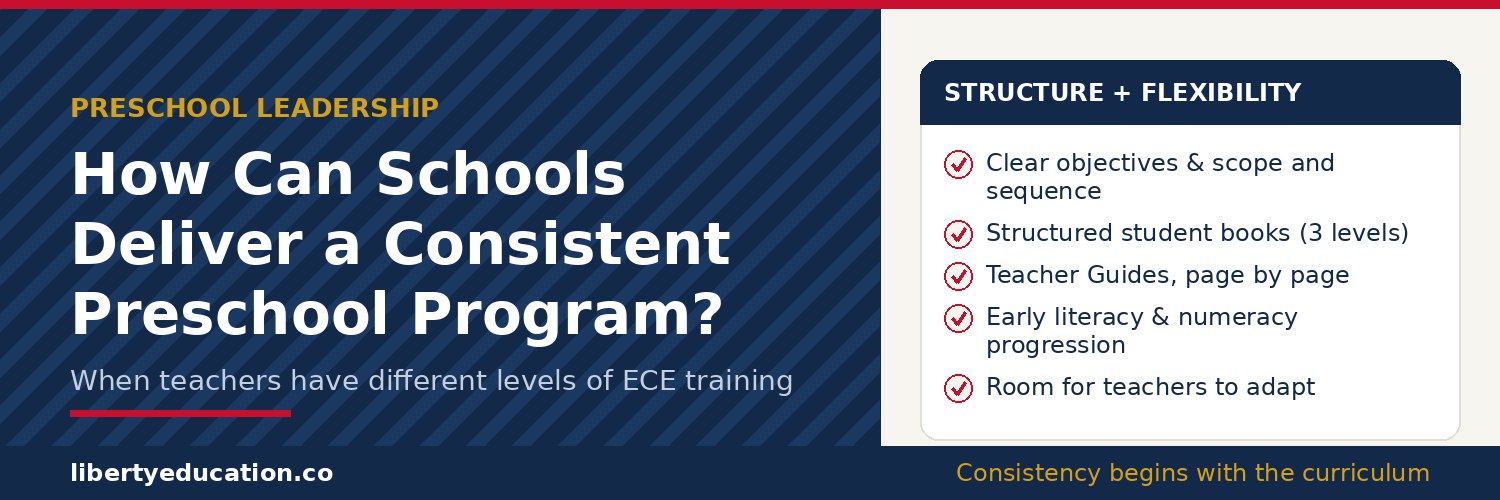
How Can Schools Deliver a Consistent Preschool Program When Teachers Have Different Levels of ECE Training?
In many international and developing-market schools, preschool teachers do not all enter the classroom with the same level of Early Childhood Education training.
That creates a practical challenge for school leaders.
How do you maintain quality and consistency across classrooms without turning teaching into a rigid script?
The answer starts with the curriculum.
A strong preschool curriculum should do more than describe good early learning. It should give teachers a clear pathway for delivering it.
Consistency Begins With Structure
Teachers need to know what children are expected to learn, what comes next, and how classroom activities connect to those objectives.
That means providing:
-
clear learning objectives;
-
a logical scope and sequence;
-
structured student materials;
-
practical Teacher Guides;
-
suggested activities and adaptations;
-
strong progression in early literacy and numeracy.
Without this structure, curriculum quality can depend too heavily on the experience of the individual teacher.
The Books Can Become the Backbone
Liberty Education uses three levels of student books supported by Teacher Guides that follow the books page by page.
The books establish progression. The Teacher Guides help teachers translate that progression into classroom instruction.
This is particularly important where some teachers have formal ECE qualifications and others have learned primarily through classroom experience.
The objective is not to make every teacher teach in exactly the same way.
It is to make sure every classroom is moving toward the same important learning goals.
Structure Should Still Allow Flexibility
Children develop at different rates. Languages, cultures, class sizes, resources, and teacher experience also vary.
Teachers therefore need room to adjust activities, pacing, examples, and classroom discussions.
But the underlying learning objectives should remain clear.
Flexibility without structure can become inconsistency; structure without flexibility can become rigidity. Liberty provides both.
For school leaders, this balance matters.
A curriculum that combines clear progression with practical flexibility can support one teacher, multiple classrooms, an entire school group, or a much larger education system.
The real test of a preschool curriculum is not simply how good it looks on paper.
It is whether teachers can successfully deliver it in the real classroom.