Why Printed Preschool Student Books Still Matter: Connecting Curriculum, Motor Skills, and Learning Outcomes
A preschool child picks up a pencil, traces a letter, counts colorful objects, or completes a matching activity. It may look like a simple workbook exercise. But when that page is connected to a carefully structured curriculum, it becomes part of a much bigger learning journey.
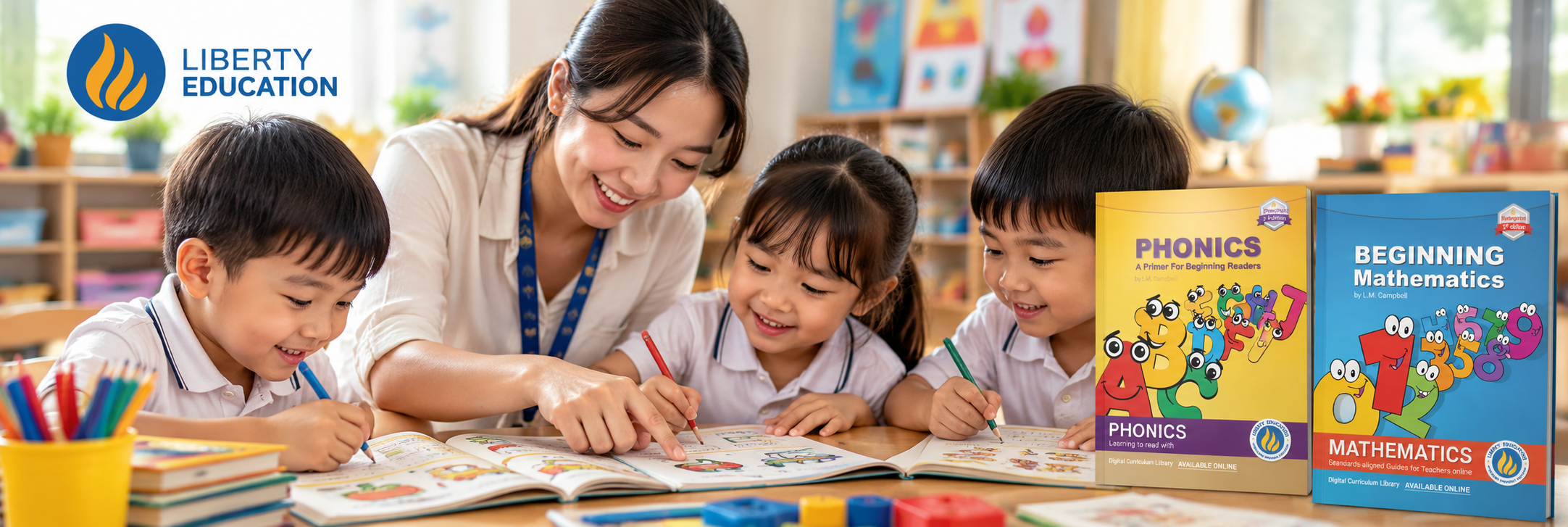
Liberty Education's Mastery Series combines printed Student Books, page-by-page Teacher Guides, hands-on activities, and curriculum-trained AI to help preschool children develop foundational Mathematics and Phonics skills.
The books are not collections of unrelated worksheets. Every page has a place in the curriculum's learning progression, supported by teaching objectives and practical classroom activities.
For teachers, this creates a clear path from one lesson to the next. For children, it connects physical activity, thinking, and early academic learning. For parents, it makes part of that learning visible.
Why Printed Student Books Are Valuable Learning Tools
Young children learn by doing. They need to touch, move, explore, listen, speak, and gradually develop control over their bodies and hands.
A well-designed preschool Student Book provides opportunities to practice important skills through activities such as:
-
Tracing and drawing: Developing pencil control, hand-eye coordination, and early writing readiness.
-
Matching and sorting: Strengthening observation, classification, and mathematical thinking.
-
Counting and identifying quantities: Connecting numbers with objects and meaningful mathematical concepts.
-
Recognizing letters and sounds: Building foundations for English Phonics and early literacy.
-
Following visual instructions: Developing attention, independence, and task completion.
These activities are especially valuable when they follow a logical learning progression rather than appearing as disconnected exercises.
The real value is not simply completing a page. It is developing the skills that the page was designed to teach.
Fine and Gross Motor Skills: Essential Foundations for Preschool Learning
Preschool education involves much more than recognizing numbers and letters.
Children also need to develop fine motor skills, which involve controlled movements of the hands and fingers, and gross motor skills, which involve larger movements, balance, posture, and coordination.
Fine motor development helps children hold pencils, draw shapes, trace letters, manipulate small objects, and eventually write with greater confidence.
Gross motor development supports movement, body awareness, coordination, and the postural control needed for many classroom activities.
Both deserve attention in early childhood education.
Printed Student Books provide opportunities to practice fine motor skills, while complementary hands-on and movement activities help children develop broader physical coordination.
For example, a teacher introducing the number five might first ask children to collect five blocks, jump five times, or count five classroom objects. Children can then return to their Student Books to recognize, trace, and work with the numeral.
The movement, manipulation, discussion, and book activity reinforce different aspects of the same learning objective.
This is how structured academic learning and developmentally appropriate preschool activities can work together.
How Liberty Education Connects Every Book Page to the Curriculum
A major strength of Liberty Education's Mastery Series is the direct connection between its Student Books and Teacher Guides.
The curriculum covers three progressive levels:
-
Nursery: Introducing numbers, shapes, colors, letters, sounds, and early pencil control.
-
Preschool: Developing counting, comparison, patterns, spatial understanding, letter formation, and sound awareness.
-
Kindergarten: Strengthening number understanding, early addition, measurement, phonics blending, and emerging English reading and writing.
Each printed Student Book follows a structured Scope & Sequence.
Every page is connected to a corresponding lesson in the online Teacher Guide, housed in the Liberty Education Learning Management System (LMS).
The Teacher Guides provide learning objectives, teaching instructions, and suggested activities that extend learning beyond the printed page.
Teachers know what children are expected to learn, which Student Book page supports the objective, and how to introduce or reinforce the concept through practical experiences.
The result is a coordinated teaching system—not just a set of books.
From Hands-On Exploration to the Printed Page
Consider a preschool Mathematics lesson about shapes.
A teacher might begin by asking children to find circles, squares, and triangles around the classroom.
Next, children could sort physical shapes, build patterns, or use their bodies to create different shapes.
Finally, they complete the corresponding Student Book activity, recognizing, matching, or drawing the shapes they have explored.
The learning objective stays consistent throughout the lesson.
The hands-on activities build understanding. The printed page provides focused practice. Together, they reinforce learning.
The same approach applies to English Phonics.
Children might listen to a story, identify a beginning sound, say related words, and participate in a movement or picture-matching game before practicing the corresponding letter in their Student Books.
This combination helps teachers address different learning needs while maintaining a clear instructional sequence.
How Curriculum-Trained AI Supports the Teaching Process
Liberty Education takes this connected approach further with a working AI Assistant trained on the Mastery Series Teacher Guides.
The Assistant references the Student Books page by page, allowing teachers to work with AI that understands the curriculum they are delivering.
Rather than generating unrelated lesson ideas, the AI provides curriculum-specific support grounded in the teaching materials.
This is particularly useful for newer teachers who may need help understanding learning objectives, preparing activities, or adapting lessons.
Experienced teachers can also use the Assistant to explore instructional options while maintaining the curriculum's progression.
The printed books provide structure. The Teacher Guides explain how to teach. The AI Assistant adds another layer of practical teaching support.
Together, these resources help schools deliver a more consistent and adaptable preschool learning experience.
Better Learning Outcomes Begin with Purposeful Teaching
A structured curriculum creates the conditions for more effective teaching, but books alone do not guarantee learning outcomes.
What matters is how teachers connect learning objectives, classroom experiences, physical activities, and opportunities for practice.
Liberty Education's approach supports this process by giving teachers:
-
A progressive Mathematics and Phonics curriculum.
-
Printed Student Books directly connected to learning objectives.
-
Online, page-by-page Teacher Guides.
-
Practical activity choices that extend beyond the book.
-
Curriculum-trained AI support for lesson preparation and delivery.
Teachers can observe how children participate, identify where additional support is needed, and adapt their activities accordingly.
This makes the Student Book one important part of a broader teaching and learning process.
Making Learning Visible to Parents
Printed Student Books also offer something digital activities cannot always provide: a physical record that children can take home, share, and keep.
Parents can see their child's early drawings, first letters, counting activities, and developing pencil control.
A teacher can open a page and explain the learning objective, what the child practiced, and how the activity connects to the curriculum.
Over time, families may notice changes in letter formation, mark-making, number recognition, and the complexity of activities.
A completed page is not proof of mastery on its own. Teachers also consider classroom observations, oral responses, hands-on activities, and what children can do independently.
But the book provides a tangible starting point for meaningful conversations about learning.
For school owners, this connection between classroom instruction and parent communication is another advantage of a well-structured printed curriculum.
A Curriculum Refined Through International Classroom Experience
Liberty Education's curriculum has been developed and refined through classroom experience in Algeria, Germany, the United States, and Cambodia.
Working with educators in different environments has helped shape a curriculum that combines structured progression with flexibility in classroom delivery.
The Mastery Series is designed to give schools a common academic foundation while allowing teachers to adapt activities to their children's developmental readiness, language, and local context.
Printed Student Books are supplied to partner schools, with selected local-printing arrangements available where appropriate.
Frequently Asked Questions
Why are printed Student Books important in preschool?
Printed Student Books provide structured opportunities to practice early Mathematics, Phonics, pencil control, visual recognition, and other foundational skills. They are most effective when connected to clear learning objectives and hands-on teaching activities.
How do preschool books support fine motor development?
Activities such as tracing, drawing, matching, and letter formation give children opportunities to practice hand-eye coordination and controlled hand movements. These skills contribute to handwriting readiness and classroom independence.
Do printed books help develop gross motor skills?
Books primarily support focused table activities and fine motor practice. Gross motor development requires movement-based experiences such as jumping, balancing, dancing, and active games. Liberty's Teacher Guide activities can help teachers connect these experiences with curriculum objectives.
How are Liberty Education's Student Books connected to the curriculum?
Every Student Book follows the Mastery Series Scope & Sequence and is supported by a corresponding page-by-page Teacher Guide in the Liberty LMS. Teachers can access learning objectives, lesson instructions, and activity choices linked to the book content.
Can printed Student Books improve preschool learning outcomes?
Well-structured books can support learning when teachers use them alongside appropriate instruction, practical activities, and observation. The quality of implementation matters more than the number of pages completed.
How does Liberty's AI Assistant support teachers?
Liberty's AI Assistant is trained on the Mastery Series Teacher Guides and references Student Book content page by page. It provides curriculum-specific support that helps teachers prepare and work with lessons.
How can Student Books help parents understand their child's progress?
Books give parents examples of classroom activities and developing skills. Teachers can use these pages alongside observations and conversations to explain learning objectives, achievements, and next steps.
More Than a Workbook: A Connected Preschool Learning System
The best preschool Student Books are not simply pages to complete. They are purposeful learning tools connected to a clear curriculum, practical teaching activities, and children's developmental needs.
Liberty Education brings these elements together through printed Student Books, online Teacher Guides, and curriculum-trained AI.
Children gain opportunities to develop foundational academic skills alongside fine motor control and hands-on exploration. Teachers gain a structured, flexible approach to instruction. Parents gain a tangible connection to their child's learning journey.
Every page has a purpose. Every lesson builds on what came before. And every activity is an opportunity to develop the skills children need for future learning.
Explore Liberty Education's Mastery Series Curriculum